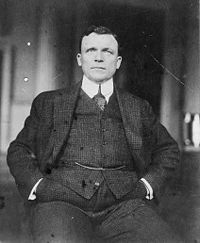
 It has been one of the more idiosyncratic aspects of Glenn Beck’s version of reality that Woodrow Wilson has become one of its central villains, with our 28th president also serving as the father of the "cancer" that is modern progressivism. Suffice it to say, no, Woodrow Wilson did not invent progressivism. Wilson fits in no easy box (one of the reasons historians keep writing about him), but certainly he embodied both progressive and conservative (even reactionary) views. Wilson certainly has many detractors on the left, who, while perhaps not as vitriolic as Beck, have found much to criticize him for, ranging from Wilson's often hypocritical foreign policy in which rhetoric (and some action) seeming to challenge imperialism cohabitated quite nicely with often imperial policies, his deep racism which saw expression in the segregating of the federal government, and his unforgivable suppression of civil liberties during World War I. Perhaps because of this, Wilson’s legacy as a sometimes quite progressive president have been sidelined, but are worth looking at. To tie these to my previous post about Beck's obsession with Obama's "radical" advisers, I want to look specifically at how major pieces of Wilson's legacy are due, in part, to the work of a "radical" adviser, who helped make the U.S. a fairer nation for the wage-earning masses.
 And with that, let us now turn to one of the great unsung heroes of the Progressive Era: Frank P. Walsh. A brilliant labor lawyer from Kansas City, Walsh served as a steady ally of Wilson in the 1912 campaign. This work caught Wilson's attention and led him to push for Walsh to chair the U.S. Commission on Industrial Relations (USCIR), a congressionally appointed body tasked with investigating the problems of labor in the new industrial economy (a commission, it is worth pointing out, created because of organized citizen pressure). Walsh devoted himself completely into the USCIR's work, often stirring up great controversy as its investigations proceeded. Among its most impressive features was the the set of witnesses the USCIR heard from, which consisted of a range of views one rarely sees invited into mainstream dialogue. Coming before the commission was everyone from Industrial Workers of the World founder "Wild Bill" Haywood to the grand industrialists such as John D. Rockefeller and Andrew Carnegie. In a rather surprising turn of events, the members of the USCIR, representing a variety of interests, disagreed with each other on the final report so vigorously that they issued three separate reports! The most important of these however was Walsh's, which also advanced the most radical analysis and recommendations. With exhaustive documentation, Walsh's USCIR report gave a greater legitimacy to the struggles of workers in a time when unions were in many ways still a rogue institution. Walsh minced no words in the report, stating that "the basic cause of industrial dissatisfaction . . . .[is] the fact that the workers of the nation, through compulsory and oppressive methods, legal and illegal, are denied the full product of their toil." He called for unions to be given the right to organize and for the society to embrace the idea that "political freedom can only exist where there is industrial freedom [and he wasn't talking about deregulation], political democracy only where there is industrial democracy."
Before discussing Walsh's further work with the Wilson administration, it is worth taking a moment to comment on where Walsh stood ideologically. While his politics are somewhat hard to describe, he certainly stood on the left end of progressivism and showed at least a comfort with, if not outright support of, socialist ideals. In a letter to Eugene V. Debs, the perennial Socialist Party candidate and hero of American radicalsim, Walsh approvingly quoted one of his staffers' summary of the USCIR report, that, “[a]ccording to this report, Eugene Debs was right, and his only mistake was in being twenty years in advance of the times.” Walsh also maintained a friendship with the renown anarchist Emma Goldman, including providing legal assistance to her. Goldman felt sufficiently ideologically compatible with Walsh to call him in her memoirs a "radically minded man." Yet, Goldman also recognized the limits of Walsh's radicalism, particularly in his close relationship not just with Wilson, but with the Democratic Party, and in the next sentence after noting his radicalism she goes on to accuse him of "political blindness and social muddle-headedness." Walsh's desire to remain connected to the Democrats and the mainstream led him away from some of his more progressive stances, as in his support U.S. entry into World War I, despite having identified himself as a pacifist. Perhaps Walsh himself best expressed the seemingly contradictory relationships and positions he found himself in when he commented to feminist activist Doris Stevens that, "I hate like hell to be so respectable."
In part 2 I will discuss Walsh's involvement in helping set the first real federal labor policy through his service on the National War Labor Board.
No comments:
Post a Comment