I don't have anything particularly original to say about the Rand Paul/Civil Rights debate, but one thought has crossed my mind. A number of folks have written about Rand Paul as fitting into the Barry Goldwater conservative mold, including in his reasons for showing, hesitation, about the Civil Rights Act of 1964. Rand's defenders do this in good part to disprove accusations that he is racist. To which I would ask: what has Rand Paul done to fight racism?
Here's the issue: to oppose federal actions/regulations to combat racism and claim that one opposes racism, it's important to show that you can show that people will take private initiatives to combat this societal cancer. While Barry Goldwater's record is by no means perfect on that, his background indicated that the idea of private action was not just a theoretical counterargument. Goldwater was a member of the Phoenix chapter of the NAACP, and not just a passive dues payer; he actively worked for desegregation, overseeing the process in his family's department stores, as well as while serving as chief of staff of the Arizona Air National Guard.
Were such efforts enough? Of course not, but it at least suggested that the libertarian critique against civil rights legislation emerged from real ideological differences, rather than as a cover for ultimately racist views. I would say that modern "Goldwater" Republicans would do well to heed that lesson if they want to be taken seriously, but we're sadly long passed the point where people care about being taken "seriously." Well, except in the DC "serious way" which means moderately liberal social values, along with a pro-bombing and entitlement cutting agenda elsewhere. Yargh.
Sunday, May 23, 2010
Wednesday, May 19, 2010
Glenn Beck Has a Point About the Left
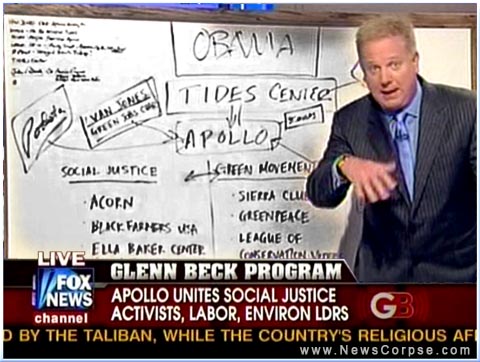
Glenn Beck Has a Point (Part I in a series)
Yeah, you read that right. While Glenn Beck’s version of the past, present, and future has been well analyzed (and challenged) elsewhere, I would like to address one strain of his critique from a slightly different angle. For anyone who’s watched Beck’s show (or seen Jon Stewart’s parodies of it) the sight of Beck scrambling around various blackboards, drawing out the nefarious connections between far-left radicals and the Obama administration are as familiar as the morning commute. Often such connections are, at best, overblown and mostly exist as fantasies easily discounted or disproven. However, Beck’s insistence that radicalism has seeped into the policies and politics of past U.S. presidents actually bears some weight (though not as much for the Obama administration, which, in my opinion, could benefit from some more heterodox, left-of-center voices having the president’s ear). Democratic and progressive presidential administrations have been influenced by more radical actors in this country, and that has often been for the good of the U.S. While there’s a long history of radical movements making demands on the government, I would like to focus on one aspect of this relationship: the role of individuals who had (or continued to) travel in more radical circles who ended up becoming key influences on or members of past presidential administrations. This has been a specific fascination for Beck, visible most infamously in his campaign against presidential adviser Van Jones.
Radicals in the White House
In the next few posts I will explore a few “radical” figures who have become members of past administrations and used those perches to fight for social change. First, it is worth saying a few words about such individuals more generally. What do I mean by saying there have been “radical figures” in the White House? Primarily these have been individuals who have been appointed to various commissions, agencies, or cabinet posts whose political beliefs and experiences were forged (at least in part) through encounters with left-wing ideas and groups (the Socialist Party for example). Contra Beck, most of these individuals, by the time they reach an administration job, have moved towards more “moderate” positions (though not always) and such figures invariably hold very pragmatic views about making social change (otherwise they would not have the desire or ability to work for a U.S. president). Even with these caveats, their goals have often been thwarted and their influence should not be overstated. Despite the many obstacles in their way however, some of the key legislative and political progress on labor rights, social insurance, and civil rights in the U.S. are partially because of such figures.
So stay tuned; first up we'll add more kindling to Beck's Woodrow Wilson hate fire through a look at attorney and labor champion Frank Walsh.
Thursday, May 6, 2010
Movies & Memory: The Hurt Locker, Green Zone and the Politics of Iraq

 How movies depict our past can often have great influence on the politics of today (just look at how Birth of a Nation reinforced the racist vision of the Reconstruction era). In thinking about such issues I would like to look at two recent films, The Hurt Locker and Paul Greengrass’ Green Zone, as attempts to remember and understand the Second Gulf War. In doing this, I am thinking less of how audiences right now, and more how their portrayals of the conflict may affect our society’s memories and interpretations of the war decades from now.
The Hurt Locker
Although key differences separate them, both The Hurt Locker and Green Zone overlap in important ways. Primarily, they each represent an attempt to marry an escapist genre (the action-thriller) with the seriousness of war and political dramas. Because these movies aim to entertain for wide audiences, they will likely serve as cultural touchstones that future generations will encounter in learning about the Iraq war ( similar to how films such as Apocalypse Now or Full Metal Jacket are many people's introduction to the Vietnam War).
The Hurt Locker follows a three man demolition team dealing with Improvised Explosive Devices (IEDs) in and around Baghdad in 2004, using that set-up to explore some of the psychological impacts of military service. The film centers on several incidents in these men’s lives and offers a vision of how participation in war, to quote Chris Hedges, can become a “drug." The film however largely avoids the politics of the war. While we get some insights into the challenges faced by U.S. soldiers and Iraqis, the strain on soldiers’ psyches, and a general sense of the larger tragedy of armed conflict, none of this is particularly specific to the Iraq War. The Hurt Locker is perhaps best placed in a long tradition of "apolitical soldiers deal with the day-to-day of war" films that attempt to capture the flavor of a soldier's life on the ground. Yet, despite the film’s skill in portraying these themes, by not emphasizing the specific controversies associated with the Iraq War, the film also does a disservice to our long-term historical memory. To examine the Iraq War and ignore the immense political controversies at its center is akin to talking about the U.S. Civil War while ignoring slavery. Considering how memories and understandings of that war will certainly influence the thought and decisions of the public and policymakers for decades to come, we need films out there that deal with those issues directly.
Green Zone
The Hurt Locker follows a three man demolition team dealing with Improvised Explosive Devices (IEDs) in and around Baghdad in 2004, using that set-up to explore some of the psychological impacts of military service. The film centers on several incidents in these men’s lives and offers a vision of how participation in war, to quote Chris Hedges, can become a “drug." The film however largely avoids the politics of the war. While we get some insights into the challenges faced by U.S. soldiers and Iraqis, the strain on soldiers’ psyches, and a general sense of the larger tragedy of armed conflict, none of this is particularly specific to the Iraq War. The Hurt Locker is perhaps best placed in a long tradition of "apolitical soldiers deal with the day-to-day of war" films that attempt to capture the flavor of a soldier's life on the ground. Yet, despite the film’s skill in portraying these themes, by not emphasizing the specific controversies associated with the Iraq War, the film also does a disservice to our long-term historical memory. To examine the Iraq War and ignore the immense political controversies at its center is akin to talking about the U.S. Civil War while ignoring slavery. Considering how memories and understandings of that war will certainly influence the thought and decisions of the public and policymakers for decades to come, we need films out there that deal with those issues directly.
Green Zone
While a lack of interest in the war’s politics largely characterizes The Hurt Locker, the same cannot be said of Green Zone. Greengrass and Damon’s film dives headlong into the political controversies of the war, retelling the story of the months immediately following the U.S. invasion. Damon’s character, Roy Miller, is a U.S. soldier leading a team searching for the weapons of mass destruction (WMDs), the threat of which served as the invasion’s chief justification. As mission after mission uncovers nothing, Miller begins to involve himself in a somewhat fictionalized version of the labyrinthine politics that engulfed groups ranging from Ba’athist generals to Iraqi exiles to CIA and Defense Department officials.
While the absence of such weapons in Iraq has long passed as an issue of controversy, Green Zone thrusts back into our memory the sense of surprise and outrage so many people around the world felt when the much vaunted WMDs proved an absolute fiction. Here I believe the film does a real service through a sort of "emotional history"; it conveys to future generations the sense of shock an increasing number of Americans felt as it became clear that Saddam’s WMDs simply did not exist. While the U.S. (and many other nations) have certainly gone to war for dubious reasons, I cannot think of a time when the main argument for engaging in military conflict proved factually incorrect in such a clear way.
Green Zone does not stop with the WMD controversy. It also recalls the arrogance of the invasion's chief architects and supporters, and the disasters they wrought. The film does this by presenting a series of characters and events, which, while slightly fictionalized or chronologically condensed, still convey important realities. The film touches on everything from the devastation caused by looting to the dire mistake of disbanding Iraq's army without any plan of what to do with all those still armed and newly unemployed men. It also well captures the extraordinary “holier-than-thou” attitudes of many of the war hawks. This is done through characters paraphrasing some of the war’s most famous one-liners ("democracy is messy"), as well as through visual short-hand, ranging from a scene in an Abu Ghraib like prison to the "Re-Elect Bush-Cheney" posters taped on walls in various CPA buildings. One of my favorites is when the movies villain, Clark Poundstone (Green Zone's stand-in for Bremer and leading neo-conservatives), dismisses the expertise and warnings of a long-time CIA analyst as “pre-conceived ideas” and “dinosaur” thinking. One can find example after example in the lead-up to war in which its cheerleaders found ways of making actual knowledge of Iraq's history and society suspect, while ignorance became "fresh thinking." Importantly, while many of these scenes and references may seem didactic to those of us with clear memories of the actual events, I think the film’s weaving of all these elements serves its main purpose by recording in an easy-to-digest form all these elements for future generations to soak in.
The Iraqis
Green Zone does not stop with the WMD controversy. It also recalls the arrogance of the invasion's chief architects and supporters, and the disasters they wrought. The film does this by presenting a series of characters and events, which, while slightly fictionalized or chronologically condensed, still convey important realities. The film touches on everything from the devastation caused by looting to the dire mistake of disbanding Iraq's army without any plan of what to do with all those still armed and newly unemployed men. It also well captures the extraordinary “holier-than-thou” attitudes of many of the war hawks. This is done through characters paraphrasing some of the war’s most famous one-liners ("democracy is messy"), as well as through visual short-hand, ranging from a scene in an Abu Ghraib like prison to the "Re-Elect Bush-Cheney" posters taped on walls in various CPA buildings. One of my favorites is when the movies villain, Clark Poundstone (Green Zone's stand-in for Bremer and leading neo-conservatives), dismisses the expertise and warnings of a long-time CIA analyst as “pre-conceived ideas” and “dinosaur” thinking. One can find example after example in the lead-up to war in which its cheerleaders found ways of making actual knowledge of Iraq's history and society suspect, while ignorance became "fresh thinking." Importantly, while many of these scenes and references may seem didactic to those of us with clear memories of the actual events, I think the film’s weaving of all these elements serves its main purpose by recording in an easy-to-digest form all these elements for future generations to soak in.
The Iraqis
Obviously one cannot make a movie about the Iraq war without Iraqis and both films allow at least some time for understanding the dilemmas facing Iraqi citizens under U.S. occupation. One subplot in The Hurt Locker involves William James (the main character) developing a relationship with an Iraqi boy named “Beckham” who sells DVDs to U.S. soldiers on their base. There are also wrenching scenes involving a cab driver and a would-be suicide bomber that give some sense of the horrible dilemmas faced by many Iraqis under U.S. occupation. While all of this is quite commendable, it is also important to note that none of the Iraqis are really given much in the way of back stories – our understandings are mainly impressionistic (as they would have been for the U.S. soldiers), leaving many questions behind.
That problem is not absent from Green Zone, yet the film at least seems aware of it and, in my opinion, does a much better job of getting at some of the nuances of Iraqi life. Take the opening of the film. Rather than jumping right into Damon's character, the film's beginning places us in Baghdad on the first night of the U.S. bombing of Baghdad, giving viewers a sense of the terror and helplessness many Iraqis must have felt as the bombs plunged into the city.
While the primary window into the Iraqi people in The Hurt Locker is a young boy, in Green Zone it is an Iraqi man nicknamed "Freddy," who becomes Damon's translator and assistant in his quest. Despite the diminutive nickname, this character is actually fleshed out (we learn of his service in the Iraq-Iran war for example) and provides audiences a view into the complexities of how everyday Iraqis interacted with the U.S. invasion. Freddy wants to help the U.S. forces; he is grateful have removed Saddam, but remains wary of their intentions and actions.
The moment however in which I think Green Zone really excels in slipping in some deeper commentary comes near the film's end [SPOILER ALERT]. Throughout much of Green Zone Damon's character searches for a Ba'athist general, Al-Rawi, who he believes knows the real story behind Iraq's WMDs. Miller eventually captures Al-Rawi, only to see him killed by Freddy. While the viewer’s immediate reaction (via Miller) is “what the fuck did you do?” Freddy's response speaks volumes: “it is not for you to decide what happens here.” Without long, redundant exposition, we are shown the hatred so many Iraqis felt towards the Ba’ath Party and reminded of the multitude of perspectives and experiences that characterize the people of Iraq. As material for further consideration, the line also opens up a critique of the war that sees flaws not just in the incompetence of execution, but in the very idea that the U.S. has a right to intervene militarily in foreign nations in the name of democracy or stability.
Final Thoughts
In writing this, I’ve largely avoided a major issue with Green Zone that I hope to address more in other contexts, which is the dangers arising from the mixing of fact and fiction that defines the film. In remembering history, movies like Green Zone function best at capturing the spirit and emotions surrounding an event, as well as (hopefully) serving as a “gateway” that piques people’s interests to learn more. I’m sure more films will tackle the war in the future, but for the moment, here’s hoping Green Zone finds a deserving place down the line as a piece of cultural memory of the Iraq invasion. And The Hurt Locker can stand its place as a valued addition to the list of solid films about war more generally.
Subscribe to:
Posts (Atom)