Showing posts with label Glenn Beck. Show all posts

Wednesday, November 24, 2010

Remembering who "they first came for"

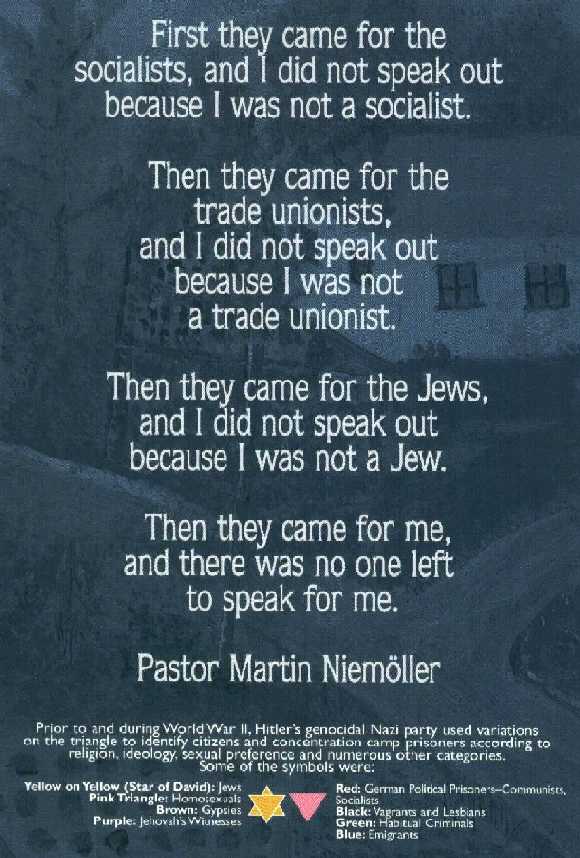
I see that Andrew Napolitano, a Fox News analyst referenced the infamous Martin Niemöller "first they came" statement regarding the TSA. Glenn Beck, in one of his daily rants against the dangers of progressive radicals, has also cited it. In these cases the quote has been trotted out to warn about the dangers of big government and progressivism. Slippery-slope arguments are perfectly fine political rhetoric, however, the constant analogizing of U.S. liberals to the Nazis, merits context about this quotation.

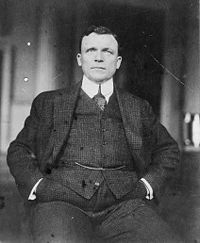
First, to the man who said it: Martin Niemöller. A conservative Lutheran minister who initially supported Hitler's rise to power,
Niemöller increasingly saw the Nazi regime as a danger that needed to be confronted. He began to speak out openly against the regime, and for that he was imprisoned in concentration camps from 1937 to 1945. His elegant words about the dangers of staying silent as different groups are targeted for persecution have become a profound and universal admonition.

That said, the quote is often misstated as referring only to Jews.
Professor Harold Marcuse at UC-Santa Barbara, whose expertise is in modern German history, has a very comprehensive website about the quotation and Niemöller. Based on that, I have placed below the most accurate version of it (emphasis added):

"First they came for the Communists, but I was not a Communist so I did not speak out.
Then they came for the Socialists and the Trade Unionists, but I was neither, so I did not speak out.
Then they came for the Jews, but I was not a Jew so I did not speak out. And when they came for me, there was no one left to speak out for me."

Yes, the people who they "first came for" were, in fact, Communists, socialists, and trade unionists. The reasons are fairly straightforward: the German left, particularly the more moderate (but still quite progressive) Social Democrats, were Hitler's chief opponents. On a practical level, they represented alternative sources of political power that Hitler needed to eliminate to assert complete control.

Ideologically, the situation is somewhat more complicated. Fascism is a frankly weird ideology, melding some left-wing ideas (a disdain for capitalism) with other views more associated with the political right (hyper-nationalism and militarism).* I hesitate to call Hitler "right-wing," but it is definitively the case that most everyone who identified as "left" in Germany opposed the Nazis.

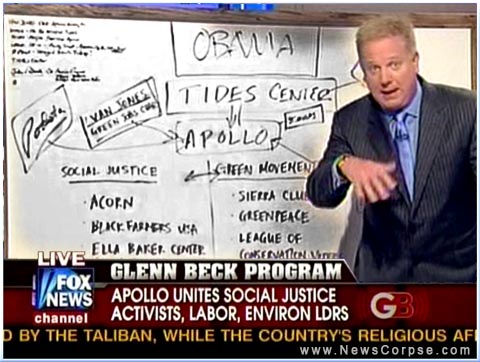
Of course, Beck and his fellow travelers cannot be bothered with such details. Speaking of Beck however, remind me again, who gives regular speeches denouncing socialism and social democracy and insisting they must be combated vigorously? And who sees unions as a malignant force in our society? Well, let's see, Glenn Beck and . . . Adolf Hitler! Why, could it be, that Glenn Beck is a Nazi sympathizer?

Actually, no. Just because he opposes some of the ideologies that fought Nazism does not make him a Nazi. There were conservatives (like
Niemöller) who stood up against the Nazis too. But sadly, such historical complexities apparently do not fit into sarcastic, ill-informed rants made in front of a chalkboard.
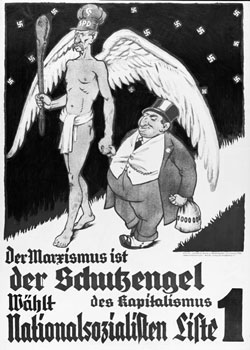

*Hopefully this image gives a sense of how difficult placing the Nazis on the conventional ideological spectrum is. This is a Nazi election poster from 1932, portraying Social Democrats and capitalists as part of the same evil; it states (paradoxically) that "Marxism is the patron saint of Capitalism."

Wednesday, September 1, 2010

Still Forgetting Walter

I swung by the "Restoring Honor" rally on Saturday which attempted (as many have pointed out) to appropriate the legacy and meaning of the black freedom struggle for the religious right/Tea Party movement. As Saddam Hussein might say, such an assertion may represent the "mother of all banalogies." This is one of those cases where interpretations of history do not even come into play, we are talking simple facts. In this case, it is an indisputable truth that Martin Luther King, Jr. and the key figures around him were progressives and had strong leanings towards Scandinavian style social democracy or more radical forms of democratic socialism. The black freedom struggle had an important economic component, one which many in the movement felt could only fully be addressed by first winning civil rights, but certainly not only through such measures. Figures in the movement forthrightly identified as progressives and attacked conservative political figures and ideas. Really the only way to miss all this is to pretend (as so many seem to) that the entire message of the movement is summed up in King's "content of their character" line, even a reading of the rest of the "I Have a Dream Speech" showcases the importance King placed on poverty and power relations.

It was this sort of assertive amnesia which reached its zenith during a video tribute to King at the rally. The longest single image from that montage featured a slow-motion shot of King at the rally sharing a joke with Walter Reuther, whose birthday is today. Now, I didn't expect people to recognize Reuther, but still the irony was overwhelming. Reuther was then president of the United Auto Workers, perhaps the most powerful (and one of the more progressive) unions in the U.S. at the time. Reuther and his compatriots, while a pragmatic lot, retained a vision of society that much more closely resembles the nightmares Beck sees in Obama's policies than in the reality of the current administration. They wanted to transform the U.S. economy through social insurance programs and economic planning to ensure full employment, good jobs, and even sustainable development.

It was these very views that helped cement an alliance (albeit one which strained and even broke at points) between the black freedom struggle and the labor movement. To cite one concrete detail, a good portion of the funding for the logistics of the August 28, 1963 rally (including the sound system which brought "I Have a Dream" to the world) came from the UAW's coffers. If Glenn Beck wants to be an heir to this he can feel free, but I have my doubts.

Thursday, July 1, 2010

Woodrow Wilson's Leftist Lawyer, Part I

It has been one of the more idiosyncratic aspects of Glenn Beck’s version of reality that Woodrow Wilson has become one of its central villains, with our 28th president also serving as the father of the "cancer" that is modern progressivism. Suffice it to say, no, Woodrow Wilson did not invent progressivism. Wilson fits in no easy box (one of the reasons historians keep writing about him), but certainly he embodied both progressive and conservative (even reactionary) views. Wilson certainly has many detractors on the left, who, while perhaps not as vitriolic as Beck, have found much to criticize him for, ranging from Wilson's often hypocritical foreign policy in which rhetoric (and some action) seeming to challenge imperialism cohabitated quite nicely with often imperial policies, his deep racism which saw expression in the segregating of the federal government, and his unforgivable suppression of civil liberties during World War I. Perhaps because of this, Wilson’s legacy as a sometimes quite progressive president have been sidelined, but are worth looking at. To tie these to my previous post about Beck's obsession with Obama's "radical" advisers, I want to look specifically at how major pieces of Wilson's legacy are due, in part, to the work of a "radical" adviser, who helped make the U.S. a fairer nation for the wage-earning masses.

And with that, let us now turn to one of the great unsung heroes of the Progressive Era: Frank P. Walsh. A brilliant labor lawyer from Kansas City, Walsh served as a steady ally of Wilson in the 1912 campaign. This work caught Wilson's attention and led him to push for Walsh to chair the U.S. Commission on Industrial Relations (USCIR), a congressionally appointed body tasked with investigating the problems of labor in the new industrial economy (a commission, it is worth pointing out, created because of organized citizen pressure). Walsh devoted himself completely into the USCIR's work, often stirring up great controversy as its investigations proceeded. Among its most impressive features was the the set of witnesses the USCIR heard from, which consisted of a range of views one rarely sees invited into mainstream dialogue. Coming before the commission was everyone from Industrial Workers of the World founder "Wild Bill" Haywood to the grand industrialists such as John D. Rockefeller and Andrew Carnegie. In a rather surprising turn of events, the members of the USCIR, representing a variety of interests, disagreed with each other on the final report so vigorously that they issued three separate reports! The most important of these however was Walsh's, which also advanced the most radical analysis and recommendations. With exhaustive documentation, Walsh's USCIR report gave a greater legitimacy to the struggles of workers in a time when unions were in many ways still a rogue institution. Walsh minced no words in the report, stating that "the basic cause of industrial dissatisfaction . . . .[is] the fact that the workers of the nation, through compulsory and oppressive methods, legal and illegal, are denied the full product of their toil." He called for unions to be given the right to organize and for the society to embrace the idea that "political freedom can only exist where there is industrial freedom [and he wasn't talking about deregulation], political democracy only where there is industrial democracy."

Before discussing Walsh's further work with the Wilson administration, it is worth taking a moment to comment on where Walsh stood ideologically. While his politics are somewhat hard to describe, he certainly stood on the left end of progressivism and showed at least a comfort with, if not outright support of, socialist ideals. In a letter to Eugene V. Debs, the perennial Socialist Party candidate and hero of American radicalsim, Walsh approvingly quoted one of his staffers' summary of the USCIR report, that, “[a]ccording to this report, Eugene Debs was right, and his only mistake was in being twenty years in advance of the times.” Walsh also maintained a friendship with the renown anarchist Emma Goldman, including providing legal assistance to her. Goldman felt sufficiently ideologically compatible with Walsh to call him in her memoirs a "radically minded man." Yet, Goldman also recognized the limits of Walsh's radicalism, particularly in his close relationship not just with Wilson, but with the Democratic Party, and in the next sentence after noting his radicalism she goes on to accuse him of "political blindness and social muddle-headedness." Walsh's desire to remain connected to the Democrats and the mainstream led him away from some of his more progressive stances, as in his support U.S. entry into World War I, despite having identified himself as a pacifist. Perhaps Walsh himself best expressed the seemingly contradictory relationships and positions he found himself in when he commented to feminist activist Doris Stevens that, "I hate like hell to be so respectable."

In part 2 I will discuss Walsh's involvement in helping set the first real federal labor policy through his service on the National War Labor Board.

Wednesday, May 19, 2010

Glenn Beck Has a Point About the Left


Glenn Beck Has a Point (Part I in a series)

Yeah, you read that right. While Glenn Beck’s version of the past, present, and future has been well analyzed (and challenged) elsewhere, I would like to address one strain of his critique from a slightly different angle. For anyone who’s watched Beck’s show (or seen Jon Stewart’s parodies of it) the sight of Beck scrambling around various blackboards, drawing out the nefarious connections between far-left radicals and the Obama administration are as familiar as the morning commute. Often such connections are, at best, overblown and mostly exist as fantasies easily discounted or disproven. However, Beck’s insistence that radicalism has seeped into the policies and politics of past U.S. presidents actually bears some weight (though not as much for the Obama administration, which, in my opinion, could benefit from some more heterodox, left-of-center voices having the president’s ear). Democratic and progressive presidential administrations have been influenced by more radical actors in this country, and that has often been for the good of the U.S. While there’s a long history of radical movements making demands on the government, I would like to focus on one aspect of this relationship: the role of individuals who had (or continued to) travel in more radical circles who ended up becoming key influences on or members of past presidential administrations. This has been a specific fascination for Beck, visible most infamously in his campaign against presidential adviser Van Jones.

Radicals in the White House

In the next few posts I will explore a few “radical” figures who have become members of past administrations and used those perches to fight for social change. First, it is worth saying a few words about such individuals more generally. What do I mean by saying there have been “radical figures” in the White House? Primarily these have been individuals who have been appointed to various commissions, agencies, or cabinet posts whose political beliefs and experiences were forged (at least in part) through encounters with left-wing ideas and groups (the Socialist Party for example). Contra Beck, most of these individuals, by the time they reach an administration job, have moved towards more “moderate” positions (though not always) and such figures invariably hold very pragmatic views about making social change (otherwise they would not have the desire or ability to work for a U.S. president). Even with these caveats, their goals have often been thwarted and their influence should not be overstated. Despite the many obstacles in their way however, some of the key legislative and political progress on labor rights, social insurance, and civil rights in the U.S. are partially because of such figures.

So stay tuned; first up we'll add more kindling to Beck's Woodrow Wilson hate fire through a look at attorney and labor champion Frank Walsh.