Showing posts with label socialism. Show all posts

Wednesday, November 24, 2010

Remembering who "they first came for"

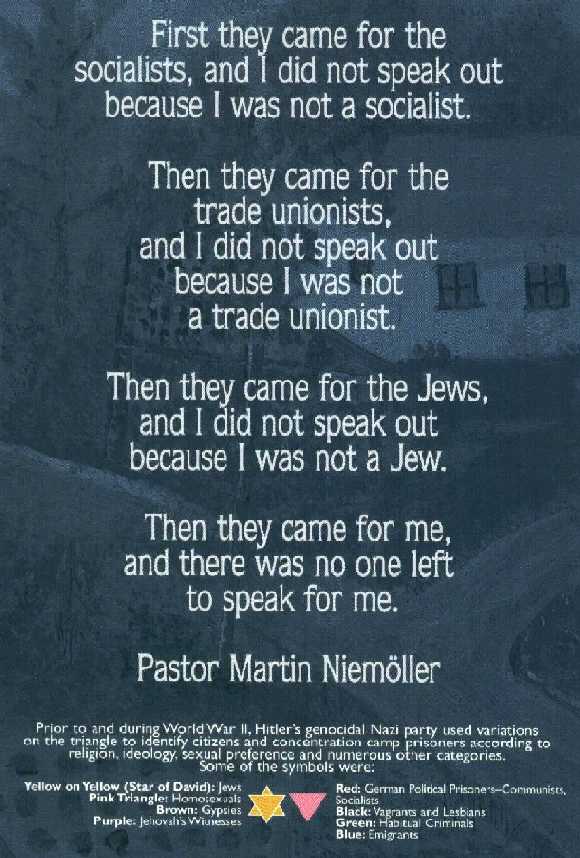
I see that Andrew Napolitano, a Fox News analyst referenced the infamous Martin Niemöller "first they came" statement regarding the TSA. Glenn Beck, in one of his daily rants against the dangers of progressive radicals, has also cited it. In these cases the quote has been trotted out to warn about the dangers of big government and progressivism. Slippery-slope arguments are perfectly fine political rhetoric, however, the constant analogizing of U.S. liberals to the Nazis, merits context about this quotation.

First, to the man who said it: Martin Niemöller. A conservative Lutheran minister who initially supported Hitler's rise to power,
Niemöller increasingly saw the Nazi regime as a danger that needed to be confronted. He began to speak out openly against the regime, and for that he was imprisoned in concentration camps from 1937 to 1945. His elegant words about the dangers of staying silent as different groups are targeted for persecution have become a profound and universal admonition.

That said, the quote is often misstated as referring only to Jews.
Professor Harold Marcuse at UC-Santa Barbara, whose expertise is in modern German history, has a very comprehensive website about the quotation and Niemöller. Based on that, I have placed below the most accurate version of it (emphasis added):

"First they came for the Communists, but I was not a Communist so I did not speak out.
Then they came for the Socialists and the Trade Unionists, but I was neither, so I did not speak out.
Then they came for the Jews, but I was not a Jew so I did not speak out. And when they came for me, there was no one left to speak out for me."

Yes, the people who they "first came for" were, in fact, Communists, socialists, and trade unionists. The reasons are fairly straightforward: the German left, particularly the more moderate (but still quite progressive) Social Democrats, were Hitler's chief opponents. On a practical level, they represented alternative sources of political power that Hitler needed to eliminate to assert complete control.

Ideologically, the situation is somewhat more complicated. Fascism is a frankly weird ideology, melding some left-wing ideas (a disdain for capitalism) with other views more associated with the political right (hyper-nationalism and militarism).* I hesitate to call Hitler "right-wing," but it is definitively the case that most everyone who identified as "left" in Germany opposed the Nazis.

Of course, Beck and his fellow travelers cannot be bothered with such details. Speaking of Beck however, remind me again, who gives regular speeches denouncing socialism and social democracy and insisting they must be combated vigorously? And who sees unions as a malignant force in our society? Well, let's see, Glenn Beck and . . . Adolf Hitler! Why, could it be, that Glenn Beck is a Nazi sympathizer?

Actually, no. Just because he opposes some of the ideologies that fought Nazism does not make him a Nazi. There were conservatives (like
Niemöller) who stood up against the Nazis too. But sadly, such historical complexities apparently do not fit into sarcastic, ill-informed rants made in front of a chalkboard.
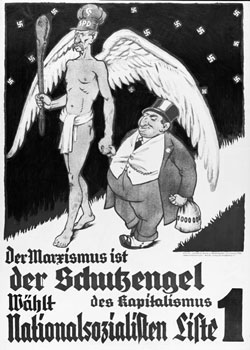

*Hopefully this image gives a sense of how difficult placing the Nazis on the conventional ideological spectrum is. This is a Nazi election poster from 1932, portraying Social Democrats and capitalists as part of the same evil; it states (paradoxically) that "Marxism is the patron saint of Capitalism."

Tuesday, November 23, 2010

A Very Hayekian Thanksgiving?

This past Sunday’s New York Times points to yet another battlefield in the war of historical interpretation that is one of many fronts in our current ideological conflict. This time, it is the stories of the initial failures and later successes of the Jamestown and Plymouth colonies that serve as convenient fables proving the universal superiority of the pure free market. Specifically, conservatives attribute these colonies’ initial hardships to the fact that “the first settlers were actually early socialists. They realized the error of their collectivist ways and embraced capitalism, producing a bumper year, upon which they decided that it was only right to celebrate the glory of the free market and private property.”

What this example demonstrates is that any historical episode can be employed to “prove” a political perspective’s assertions, as long as the analysis is kept generalized. Such as by claiming that Jamestown and Plymouth actually are evidence that markets lead to disaster and only heavy state intervention provides stability and growth. Observe.

In the case of Jamestown, a strong argument can be made that the obsession with profits over other community needs characterizing the colony's early years (as well as a conservative view on how capitalism best functions) caused many of the colony’s troubles. In its first decades, Jamestown was run by the seventeenth century version of a multinational corporation, the Virginia Company. As historian Karen Kupperman (who is interviewed in the article) describes, the drive for profit pushed by the company meant that “much attention was diverted from building essential infrastructure to the continuing effort to find those indispensable ‘marchantable commodities.’” To take one concrete example, the initial colonists sent by the Virginia Company included numerous individuals expert in mining and metallurgy, but fewer who knew about agriculture.

In fact, the private management of Jamestown proved so problematic that in 1624 the colony underwent a seventeenth century version of nationalization, becoming a royal colony administered directly by the crown. This change happened after a government investigation uncovered evidence of severe mismanagement by the Virginia Company, even as its directors collected scandalously large salaries. Jamestown's transformation to a royal colony had beneficial results; in its aftermath began a “great period of varied production” that included everything from brewing to gun making (oh Virginia).

So Jamestown proves the universal superiority of state-run institutions over private, profit-seeking ones? Hardly. There are of course state-run institutions that run with great efficiency. There are also private businesses that run competently. The crises of Jamestown's early years had as much to do with disease and bad weather as it did with how English colonists organized themselves economically. And while I cannot speak to the details, I would expect that studying a seventeenth-century royal colony can tell you as much about modern day state-run enterprises as studying radical Republicans circa 1866 can tell you about radical Republicans today (ie., a little, but not much).

How about Plymouth? The Times article notes the central thesis for conservatives lies with the changes in land distribution. Initially, Plymouth’s farm lands were communal (which proved disastrous) and then they were divided into individual plots (which proved successful). Not being an expert on this, it sounds plausible; collective agriculture has certainly seen its historical disasters, and a lot depends on the dynamics of the community. The article quotes scholars who note (as could be expected) a number of other factors were at play (such as the Pilgrims becoming better farmers with time). Furthermore, what the conservative account ignores is that, while the Pilgrims may have given up on communal ownership, they maintained policies around land to promote general social welfare. Looking over the right-wing “Great Thanksgiving Hoax” site, one is hard pressed to find the portion of Plymouth governor William Bradford’s decree on creating individual land ownership that also required farmers to set aside some of their food for those who needed it; “a portion for public fishermen &c. who could not work” to quote directly. Apparently even privatization could not kill welfare socialism.

As always, the take-away message is that simplified history does a disservice not only to understanding the past, but also for interpreting the present and building for the future.