Showing posts with label unions. Show all posts

Saturday, February 19, 2011

Thomas Paine and the Wisconsin Workers

A quick note: I see that Tea Party groups are organizing a march to counter the massive protests being spearheaded by pubic workers in Wisconsin, a response to the governors' attempt to essentially eliminate public sector unions. I will be shocked if, as usual, the founders' eighteenth century economic thought and broad ideas are not easily converted by that march into a standard union-busting drumbeat from the days of the Pinkertons.

Uncomfortably for the Tea Partiers, when we examine the actual record of a key revolutionary icon, Thomas Paine, we find a man who himself was an agitator for justice and dignity for public workers. Paine's legacy for U.S. independence is of course vital; he famously wrote the pamphlet Common Sense, which played a crucial part in moving many North American colonists firmly in support of independence and the construction of a democratic state. Paine, however, was not a long-time resident of the colonies - in fact he only moved to Philadelphia in 1774.

What was he doing before? Well, most immediately prior, he had worked as an Officer of Excise, a tax collector, in Lewes, England. That is until he joined a movement of fellow excise officers demanding that their wages be increased to allow these public servants to escape poverty. Throughout the winter of 1772-1773 Paine worked to organize and prepare a petition to Parliament, an attempt which failed. The following year Paine was fired from his job and would make his way to Philadelphia.

The main contribution Paine made to this effort was to write his first political pamphlet, The Case of the Officers of Excise. While many of the specifics in this piece are more relevant to the eighteenth century world, in it we can find some of the same principles at work in Wisconsin today:

On the problems of low wages:

When a Year’s Salary is mentioned in the Gross, it acquires a Degree of Consequence from its Sound, which it would not have if separated into daily Payments, and if the Charges attending the receiving and other unavoidable Expences were considered with it. Fifty Pounds a Year, and One Shilling and Ninepence Farthing a Day. carry as different Degrees of Significancy with them, as My Lord’s Steward, and the Steward’s Labourer; and yet an Out-Ride Officer in the Excise, under the Name of Fifty Pounds a Year, receives for himself no more than One Shilling and Ninepence Farthing a Day.

After Tax, Charity, and sitting Expences are deducted, there remains very little more than Forty-six pounds; and the expences of Horse-keeping in many Places cannot be brought under Fourteen Pounds a Year, besides the Purchase at first, and the Hazard of Life, which reduces it to Thirty-two Pounds per Annum, or One Shilling and Ninepence Farthing per Day.

On the questions of wealth and poverty:
The Rich, in Ease and Affluence, may think I have drawn an unnatural Portrait; but could they descend to the cold Regions of Want, the Circle of Polar Poverty, they would find their Opinions changing with the Climate. There are Habits of Thinking peculiar to different Conditions, and to find them out is truly to study Mankind.
The final call for justice:

With an Addition of Salary, the Excise would wear a new Aspect, and recover its former Constitution. Languor and Neglect would give Place to Care and Chearfulness. Men of Reputation and Abilities would seek after it, and finding a comfortable Maintenance, would stick to it. The unworthy and the incapable would be rejected; the Power of Superiors be re-established, and Laws and Instructions receive new Force.
Wednesday, November 24, 2010

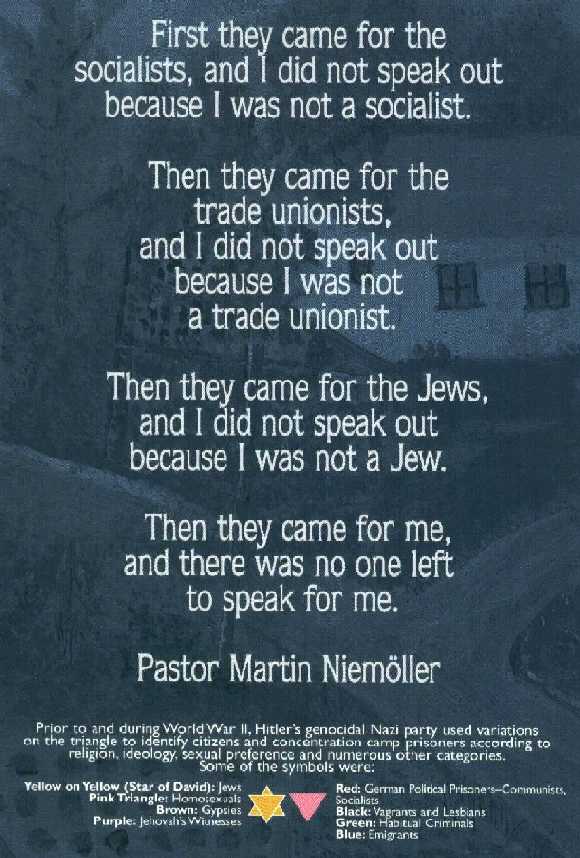
Remembering who "they first came for"

I see that Andrew Napolitano, a Fox News analyst referenced the infamous Martin Niemöller "first they came" statement regarding the TSA. Glenn Beck, in one of his daily rants against the dangers of progressive radicals, has also cited it. In these cases the quote has been trotted out to warn about the dangers of big government and progressivism. Slippery-slope arguments are perfectly fine political rhetoric, however, the constant analogizing of U.S. liberals to the Nazis, merits context about this quotation.

First, to the man who said it: Martin Niemöller. A conservative Lutheran minister who initially supported Hitler's rise to power,
Niemöller increasingly saw the Nazi regime as a danger that needed to be confronted. He began to speak out openly against the regime, and for that he was imprisoned in concentration camps from 1937 to 1945. His elegant words about the dangers of staying silent as different groups are targeted for persecution have become a profound and universal admonition.

That said, the quote is often misstated as referring only to Jews.
Professor Harold Marcuse at UC-Santa Barbara, whose expertise is in modern German history, has a very comprehensive website about the quotation and Niemöller. Based on that, I have placed below the most accurate version of it (emphasis added):

"First they came for the Communists, but I was not a Communist so I did not speak out.
Then they came for the Socialists and the Trade Unionists, but I was neither, so I did not speak out.
Then they came for the Jews, but I was not a Jew so I did not speak out. And when they came for me, there was no one left to speak out for me."

Yes, the people who they "first came for" were, in fact, Communists, socialists, and trade unionists. The reasons are fairly straightforward: the German left, particularly the more moderate (but still quite progressive) Social Democrats, were Hitler's chief opponents. On a practical level, they represented alternative sources of political power that Hitler needed to eliminate to assert complete control.

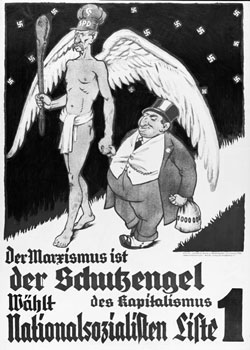
Ideologically, the situation is somewhat more complicated. Fascism is a frankly weird ideology, melding some left-wing ideas (a disdain for capitalism) with other views more associated with the political right (hyper-nationalism and militarism).* I hesitate to call Hitler "right-wing," but it is definitively the case that most everyone who identified as "left" in Germany opposed the Nazis.

Of course, Beck and his fellow travelers cannot be bothered with such details. Speaking of Beck however, remind me again, who gives regular speeches denouncing socialism and social democracy and insisting they must be combated vigorously? And who sees unions as a malignant force in our society? Well, let's see, Glenn Beck and . . . Adolf Hitler! Why, could it be, that Glenn Beck is a Nazi sympathizer?

Actually, no. Just because he opposes some of the ideologies that fought Nazism does not make him a Nazi. There were conservatives (like
Niemöller) who stood up against the Nazis too. But sadly, such historical complexities apparently do not fit into sarcastic, ill-informed rants made in front of a chalkboard.


*Hopefully this image gives a sense of how difficult placing the Nazis on the conventional ideological spectrum is. This is a Nazi election poster from 1932, portraying Social Democrats and capitalists as part of the same evil; it states (paradoxically) that "Marxism is the patron saint of Capitalism."