Friday, September 24, 2010

The Battle to Claim the Founders, Part 105896

Ron Chernow's piece in the New York Times today about the relationship (or lack thereof) between the Tea Party's views and the thought of the founders is well worth reading. The sections detailing debate over different interpretations of the Constitution are really fascinating (I did not realize just how quickly arguments over how "strict construction" emerged!) That said, Chernow's piece contains some slightly puzzling assertions. Most problematically, he writes as if clear lines of lineage exist from the two original political parties in the U.S., the Federalists and Republicans, to our modern day political ideas and parties. For example, here is Chernow on Jefferson and the Tea Party:
Jefferson and his Republicans (not related to today’s Republicans) advocated states’ rights, a weak federal government and strict construction of the Constitution. The Tea Party can claim legitimate descent from Jefferson and Madison, even though they founded what became the Democratic Party.
This is unfortunately what happens when you take general philosophical ideals expressed in the past and wrench them out of their specific social, economic, and political context. It is true that Jefferson and Madison believed in concepts such as "weak federal government." The critical political experience in their lives up to the point of the revolution had been dealing with an authoritarian British government which clamped down severely on independent governance. Yet, that does not necessarily translate into saying that Jefferson's reasons for advocating small government bear no difference that those espoused by the Tea Party. As I wrote about in a previous entry, Jeffersonian opposition to large government had much to do with the fear that a strong federal state would employ its power to maintain and expand the power of wealthy interests (including private businesses), at the expense of independent farmers and working people. Not exactly the philosophical underpinnings of modern conservatism in the United States.

Furthermore, Chernow seems to imply that Washington and Hamilton represent the fore-bearers of American liberalism; after all they "espoused a strong federal government, led by a powerful executive branch, and endorsed a liberal reading of the Constitution." Yet, such a reading seems to fall into the trap that if conservatives are for "small government" philosophically, then liberals must be for "big government." Hamilton's desire for big government came in large part out of a desire to create a strong, imperial state and to promote the development of large enterprises and businesses. While progressives do not categorically oppose such concepts, philosophically they see a strong state as a tool to help the marginalized in society and provide a check on powerful private influences. Try pairing that with a key Hamilton statement on his vision for the new government and society:

"All communities divide themselves into the few and the many. The first are the rich and well born, the other the mass of the people . . . The people are turbulent and changing; they seldom judge or determine right. Give therefore to the first class a distinct, permanent share in the government. They will check the unsteadiness of the second, as they cannot receive any advantage by change, they therefore will ever maintain good government."
Chernow's piece and any similar ones are incredibly welcome to creating a more historically accurate and complex political dialogue. What I would merely propose is that when we talk about the founders in today's politics, let's render them (to a realistic extent), the complexities of their views. One can find relevant political ideas not only from the "founding fathers," but from the slaves, working men, women activists, and so many others who forged the nation. But we should not pretend that any of us are their direct and unique descendants.
Sunday, September 19, 2010

At least no one has suggested this yet...

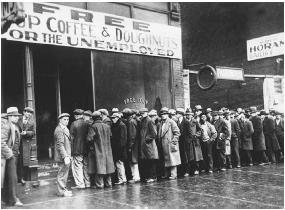
Important elements in the conservative movement and Republican Party have not exactly shown the greatest compassion for the unemployed during our current Great Recession. Much of the rhetoric has focused on implying that the unemployed are "lazy" or just not looking hard enough for jobs. Such rhetoric has a long history, but fortunately today's conservatives have steered clear of some of the extreme demands made in the past to further immiserate the unemployed. This was not the case during the Great Depression.

In 1934 a conservative business organization, the New York State Economic Council, put forward a stunning proposal. The organization had been formed as an anti-New Deal coalition headed by former Attorney General (under President Taft), George Wickersham. As historian Alexander Keyssar describes the NYSEC, it was an "influential voice urging lower taxes and reduced government expenditures to promote business recovery; it also opposed 'compulsory' unemployment insurance, denounced the American Federation of Labor as 'un-American,' and recommended the passage of laws outlawing general and sympathetic strikes."

Sounds a bit familiar, yes? However, the NYSEC's fears about government expansion moved beyond economic policies to focus on the electoral effects of the New Deal. Namely, the NYSEC saw government relief programs as potentially creating millions of dependent individuals, who would mindlessly vote for Democrats in order to get government monies. Thus, among the policy proposals they advocated included the "withholding from all persons receiving public unemployment relief the right of suffrage during the period in which such relief is being received." Officials with the NYSEC, reflecting the kind of fears later used about welfare recipients (read: African-American welfare recipients) regarding dependence on government monies creating voters loyal to one political party over another.

Fortunately, the proposal went nowhere. And if anything, perhaps such examples can help moderates and progressives breath a sigh of relief: we've had nutty ideas in the body politic before, but so far (more or less), the republic seems to have survived.

Monday, September 13, 2010

Three Random Thoughts on D'Souza

Dinesh D'Souza's cover article for Forbes (lovingly seconded by Newt Gingrich, who, on behalf of all people who have or are working to get U.S. history PhDs, I apologize for), so overflows with shoddy arguments that there's not really time to delve into all of them. A number of great writers have already done the job of skewering D'Souza's faulty logic and I especially recommend Adam Serwer's brilliant post on how the piece fits into larger conservative arguments. That said, I have three fairly unconnected thoughts:

1) Not An Original Smear: The notion that a U.S. president bases his allegiance to some foreign ideology is by no means a new one. In fact, a long history exists of political opponents attempting to link their opponents to some foreign (and radical) ideology, thus discrediting them completely. One of the first victims of such attacks was Thomas Jefferson, who, particularly in his 1800 campaign, came under constant attack by Federalists claiming his allegiance lay with the French Revolution, not the American. One such controversy involved a 1796 letter Jefferson wrote to Philip Mazzei, in which he expressed concerns over the political path the fledgling nation had embarked under Federalist rule. The Federalist press rushed to imply that Jefferson had abandoned his loyalty to the U.S., with one key Federalist newspaper, the New York Minerva, printing excerpts of the letter and commenting that, "it seems hardly possible an American could be capable of writing such a letter." Ironically, Jefferson's letter to Philip Mazzei itself indulged in the same type of rhetoric, arguing that Federalist policies had created "in place of that noble love of liberty and republican government which carried us triumphantly thro' the war, an Anglican, monarchical and aristocratical party had sprung up, whose avowed object is to draw over us the substance as they have already done the forms of the British government." As one more example, some opponents of Abraham Lincoln viewed him as overly close with various European exiles in the U.S. who had been leaders in the famed 1848 revolutions in Europe, seeing their often strong abolitionist views as marking the entry of foreign notions into American politics.

2) Stop Pretending You Knew the Founders: In the piece D'Souza attempts to figure out "Obama's dream" and notes that "[it] is certainly not the American dream as conceived by the founders. They believed the nation was a 'new order for the ages.'" As I wrote about before, the claim that one's own opinions truly reflect those of the "founding fathers" remains one of the most persistent and frustrating memes in modern uses of historical example. The founding generation had a great diversity of opinion about the "American dream" and what American identity meant. Certainly, a Hamilton and a Jefferson didn't agree about what form the U.S. economy should take. And the slaves who fought for the pro-independence side most likely viewed themselves as "American," even if most of the founders did not. The same goes for women who lobbied for (and in New Jersey briefly won) suffrage and other rights, but were denied an equal place in U.S. society.

D'Souza also revives a conservative attack on Obama which accuses him of denying the existence of "American exceptionalism," calling into question his motivations for being president. Taking a look at the full Obama quote, this is at best a gross oversimplification. And it certainly does not mark a rejection of the founders. Obama's view of American exceptionalism is that there are a number of laudable and unique characteristics about U.S. culture and history. That said, Obama did not claim the U.S. to be empirically "better," rather noting that other nations have their own exceptional characteristics, and that together a better world can be built. Such sentiments clearly echo certain strains of thought and values from the revolutionary generation, especially those expressed in word and deed by Thomas Paine, who saw the U.S. as exceptional, but believed much of what was best about the U.S. could be spread abroad through an international struggle for liberty.

3. Read Some African History: D'Souza's term "Kenyan anti-colonialism" is rather amusing in its ignorance of African history (and I'm no expert). I get that he's using this as short-hand to refer to the larger, post-colonial move by many African and Asian nations, reflected in the 1970s push for a New International Economic Order, which challenged global economic structures with a far-reaching program of reform. However, Kenya was never a major participant in those movements and its development strategy in the late 1960s and onwards focused on inviting in foreign investment, not internal, state-led development. You know, the kind of policies D'Souza favors.

Monday, September 6, 2010

Labor on the Screen

In time for Labor Day here is a non-representative sample of four of my favorite on-screen depictions of organized labor from U.S. history:

(1) Matewan: John Sayle's account of the 1920 strike by coalminers in the West Virginia town of Matewan conveys better than any other film I've seen the lives, struggles and issues surrounding workers in the U.S. at the opening of the 20th century. The film digs not only into the relationship of workers and bosses, showing the extreme measures undertaken by companies to stop unionization, but also addresses how the racial and ethnic diversity of the U.S. (this was a time when being an Italian or a Pole or a Jew set one apart from the white Anglo-Saxon norm) played into labor's fights. A fascinating sequel is yet to be made depicting the West Virginia Mine Wars that the Matewan incident ignited. That conflict culminated in the Battle of Blair Mountain, where around 10,000 armed miners fought against private security forces, state militia and eventually federal troops (who even used bomber planes from World War I) in the largest insurrection in U.S. history since the Civil War.

Here's a key scene from Matewan that plays as an excellent (if slightly didactic) primer on race and labor, with a lot of resonance for today:


(2) Salt of the Earth: Of the films on this list this is certainly the forthrightly propagandistic. The film is based on a real strike by mainly Mexican-American workers against the Empire Zinc Company in 1951. Salt of the Earth has achieved a level of infamy because many of the key figures who made it were members or allies of the Communist Party and the union it examined, the International Union of Mine, Mill and Smelter Workers, was expelled from the CIO in 1950 for its leaderships' communist affiliations. Given the film's 1954 release, it suffered the full effects of McCarthyism, going largely unseen at the time of its release and only slowly becoming recognized as a classic of political film making. Most of the actors and actresses are non-professionals and in fact are the very people the story is based on. While partially worth viewing purely for its historical value, Salt of the Earth is also remarkable in its forthright feminism, as the union men learn to respect their female comrades (remember this is at least a decade before the "second-wave" feminist movement truly came into its own). Additionally, the portrait of conflicts between Mexican-American and "Anglo" workers carries obvious importance for today.

Here are the first ten minutes:


(3) Norma Rae: It's really too bad Sally Fields' "you like me" Oscar speech is better remembered than the message of Norma Rae. The film is somewhat similar to Matewan in its exploration of the tensions between an outside union organizer and the local workers. Based on the life of Crystal Lee Sutton and the campaign by the Amalgamated Clothing and Textile Workers Union to organize the J.P. Stevens company, a notoriously anti-union company based largely in the South (in Sutton's case, North Carolina). It's also an important film for delving fully into the added difficulties faced by women workers (who are now or soon will be the majority of union members) and by having a female protagonist it helps cut against the cinematic stereotype of union workers as burly, white men. Also a great film to see because of its focus on labor in the New South during the 1970s, a decade that's increasingly being recognized as pivotal to understanding our present, including the fate of workers in the U.S.

Here's the classic "Union" scene:


[Minor Spoilers Ahead]

(4)
The Wire, Season 2: In the show's second season we move from the inner city to the port of Baltimore and the trials and travails of a local dockworkers' union (which is closely based on the International Longshoreman's Association, that provided the inspiration for On the Waterfront). In particular, the season focuses on the efforts (legal and illegal) of the local's secretary-general, Frank Sobotka, to save his union and the decent life it has provided. The second season is sometimes seen as a detour from the main plot of the show, however thematically it is vital to understanding the modern U.S. In exploring why the drug trade proves so attractive to so many in the inner city, one must understand the impacts of deindustrialization and the failure to make the new, service heavy economy, one that produces not only jobs, but good jobs. The timing of deindustrialization is also critical for understanding the plight of so many inner city African-American communities. After World War II, many southern African-American communities increasingly moved northward to secure well-paid manufacturing work in a second Great Migration. Yet, they moved north just as those same jobs began to move south, as companies sought out less union-friendly locales, first in southern states and then overseas, leaving northern African-American communities without a strong economic base.

Put another way, what we see starting to happen with the hopelessness and turn to crime of Nick and Ziggy Sobotka is what happened to the parents and grandparents of Avon Barksdale or Bodie.

There's so much more to be said, but I'll leave it with this scene in which the police arrive at the union local's headquarters to serve subpoenas on several members. In response, Frank Sobotka delivers an impassioned speech (starting at minute 2:00) about the resilience of the unions in the face of problems caused by their own corruption, as well as attacks by business and government.

Thursday, September 2, 2010

MLK: Judge On the Content of His Actual Beliefs

Banalogies friend Seth D pointed me to this piece from the Moderate Voice, which honestly is best read as an Onion-esque parody of a "sensible" moderate position. The author, Rick Moran, seeks to find a reasonable middle ground between those who believe the Tea Party is the inheritor of the civil rights legacy and those who vehemently disagree. As Seth noted to me, Moran writes as if Martin Luther King Jr. were some ancient figure whose views on modern issues we can only speculate on. This allows him (without linking to any sources) to state, for example, that King "would have scoffed at the modern interpretation of 'social justice.'" Perhaps most ludicrous is Moran's attempt to make King out to be a skeptic of government interventions to achieve greater social justice, asserting that King would have opposed programs based on ideas of "positive rights" because he believed that "change would come only when the hearts and minds of Americans were turned from hate and that only through Christian love and charity."

This is not a matter of difference of interpretation; these statements are factually incorrect. Look at the demands of the March for Jobs and Freedom in 1963; among them are higher minimum wages and a "massive federal program to train and place all unemployed workers - Negro and white - on meaningful and dignified jobs at decent wages." When King was murdered in 1968, he was assisting with a sanitation workers' strike and building to the planned Poor People's March, which again demanded massive government intervention to end poverty.

Not only were King's views on policy clear, so were his politics. Let's take the movement's fight for voting rights. Most of the time, the struggle for full suffrage rights is discussed in a way that make the goals of the movement mainly philosophical. Thus, the main point of fighting for full suffrage rights was for African-Americans to be equal citizens to whites. While this was a vital element, King and the movement also saw gaining full voting rights as a pragmatic tactic towards larger objectives, as seen in his 1961 speech to the Transport Workers Union:

"The campaign to grant the ballot to Negroes in the South has profound implications. From all I have outlined, it is clear that the Negro vote would not be utilized in a vacuum. Negroes exercising a free suffrage would march to the polls to support those candidates who would be partial to social legislation. Negroes in the South, whether they elected white or Negro Congressmen, would be placing in office a liberal candidate, if you will-a-labor candidate. (APPLAUSE) No other political leader could have a program possessing appeal to Negroes."
How about King's views on conservatives? Well, right before receiving the Nobel Peace Prize in 1964, he gave a lecture that included comments on that year's presidential election, in which Lyndon Johnson crushed conservative champion Barry Goldwater. As Rick Perlstein and others have shown, the modern right in many ways came into its own with Goldwater's campaign and a direct line runs between the Goldwaterites and today's conservatism. Here's what King had to say about Goldwater and the right-wing movement of the day:
"Another indication that progress is being made was found in the recent presidential election in the United States. The American people revealed great maturity by overwhelmingly rejecting a presidential candidate who had become identified with extremism, racism, and retrogression. The voters of our nation rendered a telling blow to the radical right. They defeated those elements in our society which seek to pit white against Negro and lead the nation down a dangerous Fascist path."
A lot of history is open to interpretation and debate. Indeed it is often highly problematic to say what a historical figure would have said about current events. However, on the question of King and modern conservatism, there really is no question where he stood.

Wednesday, September 1, 2010

Still Forgetting Walter

I swung by the "Restoring Honor" rally on Saturday which attempted (as many have pointed out) to appropriate the legacy and meaning of the black freedom struggle for the religious right/Tea Party movement. As Saddam Hussein might say, such an assertion may represent the "mother of all banalogies." This is one of those cases where interpretations of history do not even come into play, we are talking simple facts. In this case, it is an indisputable truth that Martin Luther King, Jr. and the key figures around him were progressives and had strong leanings towards Scandinavian style social democracy or more radical forms of democratic socialism. The black freedom struggle had an important economic component, one which many in the movement felt could only fully be addressed by first winning civil rights, but certainly not only through such measures. Figures in the movement forthrightly identified as progressives and attacked conservative political figures and ideas. Really the only way to miss all this is to pretend (as so many seem to) that the entire message of the movement is summed up in King's "content of their character" line, even a reading of the rest of the "I Have a Dream Speech" showcases the importance King placed on poverty and power relations.

It was this sort of assertive amnesia which reached its zenith during a video tribute to King at the rally. The longest single image from that montage featured a slow-motion shot of King at the rally sharing a joke with Walter Reuther, whose birthday is today. Now, I didn't expect people to recognize Reuther, but still the irony was overwhelming. Reuther was then president of the United Auto Workers, perhaps the most powerful (and one of the more progressive) unions in the U.S. at the time. Reuther and his compatriots, while a pragmatic lot, retained a vision of society that much more closely resembles the nightmares Beck sees in Obama's policies than in the reality of the current administration. They wanted to transform the U.S. economy through social insurance programs and economic planning to ensure full employment, good jobs, and even sustainable development.

It was these very views that helped cement an alliance (albeit one which strained and even broke at points) between the black freedom struggle and the labor movement. To cite one concrete detail, a good portion of the funding for the logistics of the August 28, 1963 rally (including the sound system which brought "I Have a Dream" to the world) came from the UAW's coffers. If Glenn Beck wants to be an heir to this he can feel free, but I have my doubts.