Critiquing the misuses of history in politics and media and general thoughts on the intersections of history, politics, and pop culture
Thursday, March 15, 2012
Actually, Rutherford Hayes IS Important
Thursday, August 25, 2011
FDR and Obama, Pt. III: Rhetoric
Drew Westin’s New York Times article on “Obama’s passion” marks one of the more recent in a long litany of pieces taking Obama to task for not employing the bully pulpit more sharply or constantly. Progressives have obvious reason to believe that Obama could wield real power by going out and giving more speeches. After all, Obama on the presidential campaign trail proved a remarkably powerful communicator; what other candidate has ever inspired a music video based solely on one of his speeches?
Here we find another area where Obama finds himself constantly compared with Franklin Roosevelt and deemed to fall short; particularly with regards to the strength of his speeches. Over and over one can find progressives bemoaning that Obama does not call out the Republicans by name or does not hit the banker class with more robust language. In many cases, Obama's timidity finds itself contrasted with Roosevelt's fire. Almost invariably, this leads to quotations from FDR’s “welcome their hatred” speech. This was the last address he gave during the 1936 campaign, delivered to a raucous crowd at Madison Square Garden. The key portion all progressives love to cite is this:
Fiery words for sure, some of the most radical rhetoric we’ve ever heard from a U.S. president. Here is the issue: Roosevelt did not go around giving speeches like this constantly. The context in which Roosevelt felt comfortable speaking such words is vital. He knew that he would win the 1936 election and by a wide margin. The audience for this speech almost certainly included much of his critical base in 1936: the rapidly expanding union movement, particularly the militantly progressive unions of the CIO.
Writers such as Matt Yglesias and Ezra Klein have started to dub the idea that Obama could change everything through speeches the "magic bully pulpit." Their response is that presidential rhetoric rarely moves voters and can often prove counterproductive. There is a lot to this criticism. I would add that, in comparing Roosevelt and Obama, one should examine the media environment and technologies each worked within. Roosevelt literally had the ear of the nation through his constant fireside chats – he did not have to compete with hundreds of channels, Twitter, etc.
That said, one place where Obama seems noticeably weaker than Roosevelt is framing. Here I am not referring to one speech, but putting together a thematic narrative across many speeches and fireside chats (a number of which can be read here). Roosevelt as president pursued a wide range of policies, but wrapping them under the idea of a "new deal" gave some manner of coherence. In explaining why the U.S. needed a such a program, Roosevelt also acted like the college professor Obama actually was, and repeatedly explained the crisis, in terms which advanced a progressive vision of economic fairness and wariness towards the power of the corporate class. As his presidency advanced, Roosevelt managed to give all his actions a coherent framework: security. Whether old age pensions or national defense, the idea of security explained Roosevelt's vision for the United States. My friend Andrew Slack once suggested that, with his emphasis on health care, Obama should have used health as a frame: bringing health care, healing a sick economy and environment, etc. As with almost any recommendation, it is doubtful this would have transformed everything, but considering the small margins elections are decided often, every little strength can help.
Tuesday, August 2, 2011
FDR and Obama, Pt. II: Advisers
However, Roosevelt also had individuals such as Harold Ickes and Frances Perkins in his administration who pushed more left-wing economic notions. For example, it may come as a surprise that Roosevelt was not particularly keen to push for the creation of Social Security. It was his Secretary of Labor and long-time friend and ally Frances Perkins who provided the tireless voice, as well as a creative organizer, that eventually put the president fully behind creating the cornerstone of the U.S. safety net.
Turning to Obama, one is hard pressed to find comparable people. While I have seen some smart liberal bloggers make the case for Laurence Summers, even if he is not the devil some progressives believe, the man who championed financial deregulation so ardently cannot really be considered a standard bearer for U.S. social democracy. There certainly have been some progressive appointees working on economic issues: Craig Becker at the NLRB, Elizabeth Warren’s at the CFPB, and Hilda Solis at the Department of Labor for example. Yet, none of these people have ever really made up Obama’s core economic team – the people he most listens to in making policy decisions. Instead, from the start, Obama has relied on a circle of advisers such as Geithner, Summers, Gene Sperling, etc., who all essentially come from the same moderate wing of the Democratic Party.
Now, it can certainly be argued that a different set of advisers would have made no difference – all of the structural barriers remain. Certainly there is truth to that, but unless one believes the president is completely powerless before the whims of history, it is not hard to imagine how a wider spectrum of voices could have affected policy making. Take the stimulus bill for example. If, for example, a Joseph Stiglitz or Robert Reich had been a core part of that team*, it is easy to see a world where the initial proposed stimulus bill showcased more ambition – spending more money overall and concentrating those expenditures on more stimulative (and progressive) spending programs, instead of the significant percentage devoted to tax cuts. Of course, it is unlikely that such a stimulus would have passed as first offered, but in the inevitable whittling down that negotiations with Republicans would have produced, the end product could still have been larger and more impactful. Such advisers might also have pushed for more expansive programs to help struggling homeowners or tougher financial regulation.
In my next post, I will explore rhetoric as an issue uniting and dividing the two.
*Yes, Reich was a member of the economic transition team, but that is far different from being a member of the administration and being a constant counsel as the president makes decisions.
Comparing Franklin and Barack: Some Structural Differences
With President Obama recently signing legislation that (essentially) takes the Herbert Hoover approach to economic recovery, it seemed an opportune moment to delve more into every liberals' favorite presidential comparison game: Franklin Roosevelt vs. Barack Obama. When Obama was elected, it seemed within the realm of possibility that the U.S. was about to witness a period comparable to the New Deal. Suffering from the worst economic crisis since the Great Depression, with large Democratic majorities in Congress, and an inspired and activated grassroots, Obama seemed to have all the pieces in place. Today, however, U.S. economic policy remains as trapped as ever within the right-wing paradigms bequeathed to us by Ronald Reagan and the conservative movement.
Why has this happened? Could U.S. progressives have expected more from this president? I will attempt to explore these issues by further interrogating the historical analogy always present in such conversations: that Obama could have been the twenty-first century FDR. In this post, I will note some factors weighing against an Obama presidency being as transformational on progressive economic grounds as Roosevelt's was. In subsequent posts I will delve into details of specific political actions and strategies differentiating the two and try to make some judgments as to what progressives could have reasonably expected from Obama, matched against how Roosevelt tackled similar challenges.
1. Worst Economic State, Fewer Filibusters
First, it is crucial to understand just how devastating the Great Depression was, even in comparison to the current Great Recession. The Great Depression saw national unemployment levels soaring to 25%, while the Great Recession has peaked (so far) at around 10%. By the time Roosevelt came to power, the nation was desperate for solutions that would turn the ship of state away from sinking further into disaster.
Along with majorities often larger than Obama's, Roosevelt also faced a Congress where the filibuster was a rarity (and most invoked on issues threatening white supremacy in the South). Take the Glass-Steagall Act, one of the cornerstones of 1930s financial regulation (and whose dismantling in the late 1990s became emblematic of our new Gilded Age). Glass-Steagall passed the Senate in 1934 without one vote cast against! Victories such as this proved much more plausible while the filibuster lay as a mostly dormant instrument. Obama’s first two years would certainly have witnessed more progressive legislation without the stunning growth in historical terms of the filibuster’s use by Republicans and conservative Democrats. Examining bills passed by the House of Representatives from early 2009 to late 2010 (health care with a public option, cap and trade) one can get a glimpse of the more progressive legacy the presidency could have left (and this ignores legislation such as EFCA which would have had a better chance in a filibuster-less world).
2. A Weak Business Lobby
As incomprehensible as progressives may find this, the business community's ability to influence policy became much diminished in the 1930s. In a rare incident in which the elite classes found themselves strongly divided, business leaders divided between those who wanted to accommodate (or even profit) from the New Deal order and those who hoped to combat and reverse it. Conservative business interests that wished to actively fight the New Deal found themselves a fairly marginalized part of the U.S. political dialogue.
Certainly opposition existed. A number of the most prominent businessmen in the country, including the du Ponts and CEOs at General Motors looked with shock at the reforms of the New Deal. By 1934 they began to organize, creating the American Liberty League. However, it was a mark of the changed times that the New York Times could declare that "nowhere in the country has the lack of any organization of conservative interests been more acutely felt than in the financial community." Despite representing monied interests, the Liberty League proved unable to exert much influence in a nation where, as historian Kim Phillips-Fein notes, "the contrast between the lives of its [the Liberty League's] members and those of the working population of the United States had simply grown too vast." This relative lack of corporate organization and politicization would persist until the early 1970s when a swell of organizing took place that led to everything from the founding of right-wing think tanks to the emergence of the U.S. Chamber of Commerce as a mainstay of right-wing free market organizing.
Thus, Obama faces a much different political atmsophere. Business did not take nearly as hard a hit, either financially or in its reputation, as it did after the Depression. Furthermore, corporations already have a well-established political infrastructure and a commitment to using it that did not exist to near the same extent.
3. Timing
When Franklin Roosevelt started his presidency, the U.S. was entering its third year of Depression. Although Herbert Hoover’s response to the Depression included government stimulus efforts (such as road construction), his attempts to explain the crisis and offer solutions always maintained a strong conservative strain. For example, in a 1931 speech, Hoover described government programs to help the unemployed, while cautioning that, “We must avoid burdens upon the government which will create more unemployment in private industry than can be gained by further expansion of employment by the Federal Government. We can now stimulate employment and agriculture more effectually and speedily through the voluntary measures in progress.”
By 1932 Americans were ready for something sharply different and Roosevelt offered that, both rhetorically and pro grammatically. While his 1932 campaign sounded some conservative themes, Roosevelt also stressed that he would govern to serve “the forgotten man at the bottom of the economic pyramid” and his promises of “bold, persistent experimentation” rang the loudest. Roosevelt also served as a sort of “professor-in-chief” during his campaigns and presidency, telling a clear story of who caused the Depression and who was going to solve it. Americans were as open as they ever have been to such messages as this from his 1932 nomination speech:
“There are two ways of viewing the government's duty in matters affecting economic and social life. The first sees to it that a favored few are helped and hopes that some of their prosperity will leak through, sift through, to labor, to the farmer, to the small businessman. That theory belongs to the party of Toryism, and I had hoped that most of the Tories left this country in 1776.
But it is not and never will be the theory of the Democratic Party.”
Conversely, Obama’s came into office mere months after the onset of the Great Recession. In attempting to comprehend what was happening, the American public found themselves bombarded by a jumble of messages as to the causes and solutions. While the greed of Wall Street seemed a clear culprit, the bipartisan nature of the bank bailouts (whatever one thinks of them as policy), confused the ability of many voters to ascertain who was at fault. Furthermore, the American Recovery and Reinvestment Act (the “Stimulus”) came not long after and, in many Americans’ minds, the bailouts and stimulus morphed into one nebulous massive government expenditure. Thus, the stimulus, both as policy and as a metaphor for a progressive solution to the crisis became confused with a pragmatic government move that saved the financial class from their own disaster. As the nation's economy sputtered, this jumble allowed the right-wing, through the vehicle of the Tea Party, to introduce a powerful counter-narrative of why the nation remained (and remains) in the doldrums.
Monday, September 13, 2010
Three Random Thoughts on D'Souza
D'Souza also revives a conservative attack on Obama which accuses him of denying the existence of "American exceptionalism," calling into question his motivations for being president. Taking a look at the full Obama quote, this is at best a gross oversimplification. And it certainly does not mark a rejection of the founders. Obama's view of American exceptionalism is that there are a number of laudable and unique characteristics about U.S. culture and history. That said, Obama did not claim the U.S. to be empirically "better," rather noting that other nations have their own exceptional characteristics, and that together a better world can be built. Such sentiments clearly echo certain strains of thought and values from the revolutionary generation, especially those expressed in word and deed by Thomas Paine, who saw the U.S. as exceptional, but believed much of what was best about the U.S. could be spread abroad through an international struggle for liberty.
Tuesday, August 31, 2010
Wall Street and the Founding Fathers
Yesterday's New York Times provides a nice, anecdotal (and I mean that in a good way), look into the worldview of Wall Street businesspeople who supported Obama for president, but now are turning on him over financial reform and his rhetorical corporate America. Of particular note for this blog is the contention by hedge fund manager Daniel Loeb that “[a]s every student of American history knows, this country’s core founding principles included nonpunitive taxation, constitutionally guaranteed protections against persecution of the minority and an inexorable right of self-determination."Statements such as these go to what should be a core "banalogical rule": if someone is claiming their political views are the direct inheritance of the founding generation and its principles, it's likely they're oversimplifying. What makes the Founding Fathers a perpetual source of fascination and debate is that they were extremely complicated and even contradictory thinkers. Let's take as an example Thomas Jefferson, given that some of his pronouncements found themselves recruited for the complaints of businesspeople on Wall Street. Here are two Jefferson quotes on economics:
(1) "Having always observed that public works are much less advantageously managed than the same are by private hands, I have thought it better for the public to go to market for whatever it wants which is to be found there; for there competition brings it down to the minimum of value." --Thomas Jefferson to William B. Bibb, 1808. ME 12:107
(2) "Money and not morality is the principle of commerce and commercial nations... Justice, honor, faith, must yield to the necessity of keeping themselves in place. The question whether a measure is moral is never asked, but whether it will nourish the avarice of their merchants."
--Thomas Jefferson to John Langdon, 1810. (*) ME 12:376
Do those two quotes make sense in the modern left-right context? Potentially, but not easily. However, in the late 18th and early 19th centuries, in an era when merchants and large-scale businesses were only beginning to emerge, they did. Taking Jefferson and his fellow republicans as a case study, we find that the views on economics debated by the founding generation mixed a variety of viewpoints that today we associate with left and right into patterns very different than today.
Jeffersonians certainly expressed some views which fit in well with conservative politics, as seen in the first quote. Jefferson was a strong proponent of free trade and territorial expansion to provide more lands for production. Support of such policies also led Jefferson to promote an aggressive foreign policy aimed at assisting U.S. export interests, something associated with both political parties, but often criticized from a progressive perspective. Jeffersonians also opposed government subsidies to businesses, seeing them as helping to breed monopolies which undermined a real free market system. One can also find in Jefferson's opinion on the constitutionality of a national bank his fears about excessive federal government power being employed in regulating commerce.
At the same time, Jeffersonians expressed grave doubts about merchants and manufacturers, questioning their loyalty and very morality, as well as criticizing wealth inequality as a major threat to nation and justice. As one example, take this quote from James Madison, who, in speaking about the future of the nation, urged that laws be passed "which, without violating the rights of poverty, reduce extreme wealth to a state of mediocrity and raise extreme indigence to a state of comfort." To those who might find the part about property rights a counter, one can find concrete expressions of Madison's view in places such as his support for a wealth tax in Federalist No. 21. Jefferson similarly advocated versions of progressive taxation and worried constantly about the "misery" wealth inequalities created, as well as the dangers to a fair republic they represented. As the modern corporation began to take form in the early nineteenth century, Jefferson grew increasingly concerned and his writings showed at least as much antipathy to early "big business" as to "big government." As an example, in 1816 he declared that "I hope we shall crush… in its birth the aristocracy of our moneyed corporations."
What to make of this? Well, to put succinctly, Jeffersonians feared concentrated power - they believed a nation of independent farmers (white ones of course, slaves inhabited essentially a different universe), neither particularly wealthy nor poor, mostly unrestrained by government but also protected from the greed of merchants, represented the most just path for the future. Try grafting that into our modern, post-industrial national situation.
That said, I do not mean to imply that the thoughts of the founding generation bear no relevance on today. Many of the larger dynamics they faced are still issues today. Let's just remember they were complex people in a different time before enrolling them into today's fights.
Wednesday, July 21, 2010
FDR Would Appoint Elizabeth Warren
The historically-minded debate over "is Obama's presidency progressive?" seems the perfect topic for this blog, so it’s long past time I jump in. To summarize: On one side are those who look at Obama so far and see missed opportunities, political cowardice, and a presidency whose ideological marker seems more mushy third-way then strong progressivism. Obama’s failings often find themselves unflatteringly contrasted to the strength and principle that Roosevelt or Lyndon Johnson brought to achieving their legislative aims. Perhaps the most cited example of this involves contrasting some seemingly weak-willed, overly nuanced Obama talk about big business with the fire of Franklin Roosevelt's "I welcome their hatred" speech in Madison Square Garden in November 1936. One could also note the extraordinary pressure Johnson often brought on members of Congress to vote his way on particular bills or even Roosevelt’s noble (though somewhat disastrous attempt) to purge ultra-conservative Democrats with more progressive ones in the 1938 midterm elections.The other side, best represented by Michael Tomasky in his piece, "Against Despair," urges progressives to take a deep breath and look at the full records of Roosevelt and Johnson. Rather than liberal stalwarts, Tomasky and writers such as Eugene Goodheart, note the many compromises and failings of both Roosevelt and Johnson in fighting for progressive goals. One need only look at the essential exclusion of African-American workers from the original Social Security program (a compromise to Southern Democrats) to see that high progressive principle was not the only pillar Roosevelt stood upon. Overall, as Tomasky describes in writing about FDR, both his presidency and Obama’s provide clear demonstrations of the “difficulties inherent in trying to effect change, the readiness to accept half a loaf, and the regular reassurances sent to the moneyed classes that the liberals hadn’t taken over the candy store.” He then goes on to detail the historical and structural barriers Obama faces that FDR and LBJ did not: the ballooning of the filibuster, the evaporation of bipartisanship, the weakening of social movements like labor, etc.
Overall, I tend to agree with the tenor of Tomasky and others who, looking at the history, find that "all this has happened before and will happen again" so to speak, a subject I hope to come back to later. For now however, let’s focus on one area where a historical perspective does not place Obama in as good standing as an FDR: diversity of advisers.
Generally, both camps have ignored the specific issue of advisers when examining Obama historically. Goodheart does cite Obama's promotion of a "team of rivals" as a positive characteristic of his administration. At a forum about his article, I had the opportunity to ask Tomasky about Obama's lack of progressive high-level appointees; his response focused on the fact that Roosevelt’s cabinet did not overflow with aggressive liberals, but rather counted among its number several conservative appointees, such as Hans "let's cut the deficit during a depression, what could go wrong?" Morgenthau.
The point however is not to expect that Obama’s policy team would be totally culled from the precincts of The Nation or the Economic Policy Institute. Rather, where some disappointment with Obama in historical context seems merited revolves around the lack of an ideologically diverse set of core advisers. I differentiate this from his cabinet in general; on that count Secretary of Labor Hilda Solis is an obvious progressive and strong cases can also be made for many on the energy and environment team such as Stephen Chu or Lisa Jackson. Thinking specifically about the economics team, the question though is how much he listens to those outside the Geithner-Summers pole of opinion. Solis for example has dramatically transformed the Department of Labor into a force siding with working people as it should (we have Treasury and Commerce Departments to look after business after all). But does Obama listen to her about larger economic matters? How much input did Solis have in health care or financial reform? Or Jared Bernstein for that matter?
Now, one could easily fit Tomasky and co.'s overall argument on to the appointee question: with the absurd filibuster continuing as a sort of tragicomical block on reform, what good would some more progressive advisers have? Perhaps none. At the same time, who knows what political and policy options currently receive scant consideration because there are not forceful advisers to make their case. As William Leuchtenburg and others have long argued, Roosevelt did not want to expend political capital on the National Labor Relations Act, although he did not fundamentally oppose the idea. It took the great upswell and pressure of organized labor to provide the space for people Roosevelt trusted (primarily then New York Senator Robert Wagner) to lobby him personally and bring the bill over the line. Similarly, it was the relentless lobbying by Frances Perkins that helped push Roosevelt to embrace and fight for the creation of Social Security. Are there similar situations for Obama? Perhaps regarding a public option or a different sort of jobs bill?
This is where Elizabeth Warren comes in. I don't know how good Obama and her relationship is or how much weight he places on her opinions.
However, we do know that Nancy Pelosi takes Warren seriously, as do several key Senators. The fact that in the past she and Geithner have sparred to me is a big PLUS; they're both smart people and her presence could bring some needed variety and yes "rivalry" to Obama's team. Also, like strong progressives in past administrations, she can count on an independent public constituency (in some w
ays akin to Perkins, whose previous labor advocacy work gave her key allies in civil society) willing to support and assist her, one she has helped build through media appearances, including several with Jon Stewart. Certainly there are other good nominees who could run the agency competently. Warren however, would be an outsized voice, someone who could spark debate and maybe even cause some trouble from time to time. And history does show that it is often the healthy annoyances that catalyze real accomplishment.
Wednesday, May 19, 2010
Glenn Beck Has a Point About the Left

Glenn Beck Has a Point (Part I in a series)
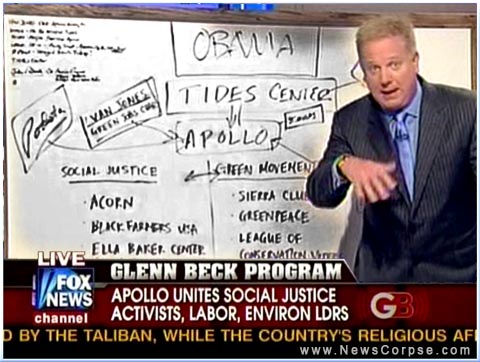
Yeah, you read that right. While Glenn Beck’s version of the past, present, and future has been well analyzed (and challenged) elsewhere, I would like to address one strain of his critique from a slightly different angle. For anyone who’s watched Beck’s show (or seen Jon Stewart’s parodies of it) the sight of Beck scrambling around various blackboards, drawing out the nefarious connections between far-left radicals and the Obama administration are as familiar as the morning commute. Often such connections are, at best, overblown and mostly exist as fantasies easily discounted or disproven. However, Beck’s insistence that radicalism has seeped into the policies and politics of past U.S. presidents actually bears some weight (though not as much for the Obama administration, which, in my opinion, could benefit from some more heterodox, left-of-center voices having the president’s ear). Democratic and progressive presidential administrations have been influenced by more radical actors in this country, and that has often been for the good of the U.S. While there’s a long history of radical movements making demands on the government, I would like to focus on one aspect of this relationship: the role of individuals who had (or continued to) travel in more radical circles who ended up becoming key influences on or members of past presidential administrations. This has been a specific fascination for Beck, visible most infamously in his campaign against presidential adviser Van Jones.
Radicals in the White House
In the next few posts I will explore a few “radical” figures who have become members of past administrations and used those perches to fight for social change. First, it is worth saying a few words about such individuals more generally. What do I mean by saying there have been “radical figures” in the White House? Primarily these have been individuals who have been appointed to various commissions, agencies, or cabinet posts whose political beliefs and experiences were forged (at least in part) through encounters with left-wing ideas and groups (the Socialist Party for example). Contra Beck, most of these individuals, by the time they reach an administration job, have moved towards more “moderate” positions (though not always) and such figures invariably hold very pragmatic views about making social change (otherwise they would not have the desire or ability to work for a U.S. president). Even with these caveats, their goals have often been thwarted and their influence should not be overstated. Despite the many obstacles in their way however, some of the key legislative and political progress on labor rights, social insurance, and civil rights in the U.S. are partially because of such figures.
So stay tuned; first up we'll add more kindling to Beck's Woodrow Wilson hate fire through a look at attorney and labor champion Frank Walsh.
Friday, April 30, 2010
Banalogies Without Comment
This may have to be a new feature: historical comparisons so stupendously inane as to exist beyond a point in which logic and argument are possible. Caught this one today from Matt Yglesias' Twitter: National Review writer Daniel Foster in responding to news about the growth in the U.S. real GDP in the first quarter of 2010 retorts that: "The Soviet economy grew every year from 1985-1989."