Showing posts with label conservatism. Show all posts

Tuesday, April 17, 2012

ALEC and DC Voting Rights

In recent weeks, one of the strongest (and yet least known about) pillars of the conservative business lobby infrastructure, the American Legislative Exchange Council (ALEC) has suddenly been thrust into the light. In the wake of the Trayvon Martin murder and the subsequent scrutiny of the "Stand Your Ground" law under which George Zimmerman claims to have acted, progressive activists turned their attentions to ALEC, which has played a key role in pushing such legislation nationwide. In taking on ALEC, groups such as Colorofchange (an online civil rights group that has spearheaded this work) began targeting corporations who pay dues as part of a membership to ALEC. The effort continues to move forward, having succeeded in winning the exit from ALEC of major companies such as Pepsi, Coca Cola, Kraft and McDonalds.

This is not the first time progressives have turned their eyes towards ALEC. During the fight in Wisconsin in early 2011 activists raised ALEC's profile and were joined in this effort by eminent UW-Madison historian William Cronon who wrote an excellent piece - and one that got him into a fair bit of trouble - that included some historical background on ALEC. Yet, there remains very little about the organization's past compared with other mainstays of the conservative movement such as the Heritage Foundation.

In investigating this, I went through the Washington Post's archives, along with a long historical paper from DC Vote and found that, at least in their pages, ALEC first major national foray came in the late 1970s, when it took the lead in fighting to prevent Washington, D.C. from gaining national legislative representation. In 1978 the U.S. House and Senate (flush with Democrats at the time) passed overwhelmingly an amendment to the constitution, the D.C. Voting Rights Amendment, which would have given D.C. the status of a state with two senators and one house member.

The rising conservative movement of the 1970s soon sprang into action, with ALEC at the head. ALEC quickly produced a fourteen page report for state legislators outlining its opposition and then spent roughly $30,000 (in 1978 dollars) to mail the booklet to every state legislator in the country. In late 1978 ALEC expended another $15,000 to bring fifty state legislators to D.C. to strategize on defeating the amendment.

The right-wing critique of the D.C. Voting Rights Amendment rode along two main thrusts. Some of the critique came wrapped in traditional constitutional arguments, stating that the law simply countermanded the intention of the Constitution that D.C. not possess the same political rights as a state. At the same time, ALEC and conservatives responded to the strong civil rights messaging of the pro-amendment side (who argued that lack of voting rights for D.C. was a civil rights issue, considering the city was majority African-American). Using rhetoric that has increasingly become a mainstay for conservatives (including famously used by figures such as George Wallace), opponents of D.C. voting rights accused supporters of employing reverse racism. ALEC head and Arizona state representative Donna Carlson stated that amendment backers were employing "the basest, indeed racist, tactics in order to railroad the amendment," further adding that critics of the amendment were "being branded as redneck racists and enemies of black Americans."

ALEC members also devised a key aspect of the legislative strategy for defeating the amendment. It called upon conservative legislators in states that did not ratify the amendment to send to the federal government "formal resolutions of disapproval" which ALEC stated "could not be rescinded, and thus would bind a state permanently against the amendment." ALEC's plan was put into motion first in Arizona (where its head was a state representative). In doing so, ALEC also took a firm stance in the ongoing conflict between moderates and the right within the Republican Party. Many Republicans backed D.C. voting rights, including Senators Robert Dole and Barry Goldwater. Meanwhile, New Right figures such as Senator Orrin Hatch and conservative intellectual Michael Novack, along with the Heritage Foundation and ALEC actively opposed.

It is important to note ALEC alone did not kill D.C. voting rights. The campaign in favor was often poorly run and the civil rights messaging proved less powerful in the states than the national level. The racial politics cut in varying ways, with United Latin American Citizens, the main Mexican-American civil rights group opposing based on fears the new (almost certainly) black representatives would "give blacks a disproportionate in lobbying for federal jobs and programs over Hispanics." Still, much of the general opposition was turned into actionable steps in good part by ALEC's efforts. By 1985 the amendment had only passed in sixteen states and the time frame for its passage had expired.

As the campaign against ALEC moves forward, it is helpful to illuminate how, for decades, the new conservative infrastructure built particularly in the 1970s has and continues to profoundly shape our politics.

Friday, September 24, 2010

The Battle to Claim the Founders, Part 105896

Ron Chernow's piece in the New York Times today about the relationship (or lack thereof) between the Tea Party's views and the thought of the founders is well worth reading. The sections detailing debate over different interpretations of the Constitution are really fascinating (I did not realize just how quickly arguments over how "strict construction" emerged!) That said, Chernow's piece contains some slightly puzzling assertions. Most problematically, he writes as if clear lines of lineage exist from the two original political parties in the U.S., the Federalists and Republicans, to our modern day political ideas and parties. For example, here is Chernow on Jefferson and the Tea Party:
Jefferson and his Republicans (not related to today’s Republicans) advocated states’ rights, a weak federal government and strict construction of the Constitution. The Tea Party can claim legitimate descent from Jefferson and Madison, even though they founded what became the Democratic Party.
This is unfortunately what happens when you take general philosophical ideals expressed in the past and wrench them out of their specific social, economic, and political context. It is true that Jefferson and Madison believed in concepts such as "weak federal government." The critical political experience in their lives up to the point of the revolution had been dealing with an authoritarian British government which clamped down severely on independent governance. Yet, that does not necessarily translate into saying that Jefferson's reasons for advocating small government bear no difference that those espoused by the Tea Party. As I wrote about in a previous entry, Jeffersonian opposition to large government had much to do with the fear that a strong federal state would employ its power to maintain and expand the power of wealthy interests (including private businesses), at the expense of independent farmers and working people. Not exactly the philosophical underpinnings of modern conservatism in the United States.

Furthermore, Chernow seems to imply that Washington and Hamilton represent the fore-bearers of American liberalism; after all they "espoused a strong federal government, led by a powerful executive branch, and endorsed a liberal reading of the Constitution." Yet, such a reading seems to fall into the trap that if conservatives are for "small government" philosophically, then liberals must be for "big government." Hamilton's desire for big government came in large part out of a desire to create a strong, imperial state and to promote the development of large enterprises and businesses. While progressives do not categorically oppose such concepts, philosophically they see a strong state as a tool to help the marginalized in society and provide a check on powerful private influences. Try pairing that with a key Hamilton statement on his vision for the new government and society:

"All communities divide themselves into the few and the many. The first are the rich and well born, the other the mass of the people . . . The people are turbulent and changing; they seldom judge or determine right. Give therefore to the first class a distinct, permanent share in the government. They will check the unsteadiness of the second, as they cannot receive any advantage by change, they therefore will ever maintain good government."
Chernow's piece and any similar ones are incredibly welcome to creating a more historically accurate and complex political dialogue. What I would merely propose is that when we talk about the founders in today's politics, let's render them (to a realistic extent), the complexities of their views. One can find relevant political ideas not only from the "founding fathers," but from the slaves, working men, women activists, and so many others who forged the nation. But we should not pretend that any of us are their direct and unique descendants.

Sunday, September 19, 2010

At least no one has suggested this yet...

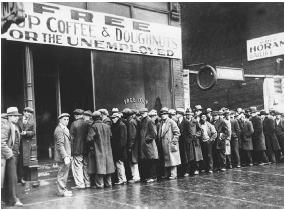
Important elements in the conservative movement and Republican Party have not exactly shown the greatest compassion for the unemployed during our current Great Recession. Much of the rhetoric has focused on implying that the unemployed are "lazy" or just not looking hard enough for jobs. Such rhetoric has a long history, but fortunately today's conservatives have steered clear of some of the extreme demands made in the past to further immiserate the unemployed. This was not the case during the Great Depression.

In 1934 a conservative business organization, the New York State Economic Council, put forward a stunning proposal. The organization had been formed as an anti-New Deal coalition headed by former Attorney General (under President Taft), George Wickersham. As historian Alexander Keyssar describes the NYSEC, it was an "influential voice urging lower taxes and reduced government expenditures to promote business recovery; it also opposed 'compulsory' unemployment insurance, denounced the American Federation of Labor as 'un-American,' and recommended the passage of laws outlawing general and sympathetic strikes."

Sounds a bit familiar, yes? However, the NYSEC's fears about government expansion moved beyond economic policies to focus on the electoral effects of the New Deal. Namely, the NYSEC saw government relief programs as potentially creating millions of dependent individuals, who would mindlessly vote for Democrats in order to get government monies. Thus, among the policy proposals they advocated included the "withholding from all persons receiving public unemployment relief the right of suffrage during the period in which such relief is being received." Officials with the NYSEC, reflecting the kind of fears later used about welfare recipients (read: African-American welfare recipients) regarding dependence on government monies creating voters loyal to one political party over another.

Fortunately, the proposal went nowhere. And if anything, perhaps such examples can help moderates and progressives breath a sigh of relief: we've had nutty ideas in the body politic before, but so far (more or less), the republic seems to have survived.

Thursday, September 2, 2010

MLK: Judge On the Content of His Actual Beliefs

Banalogies friend Seth D pointed me to this piece from the Moderate Voice, which honestly is best read as an Onion-esque parody of a "sensible" moderate position. The author, Rick Moran, seeks to find a reasonable middle ground between those who believe the Tea Party is the inheritor of the civil rights legacy and those who vehemently disagree. As Seth noted to me, Moran writes as if Martin Luther King Jr. were some ancient figure whose views on modern issues we can only speculate on. This allows him (without linking to any sources) to state, for example, that King "would have scoffed at the modern interpretation of 'social justice.'" Perhaps most ludicrous is Moran's attempt to make King out to be a skeptic of government interventions to achieve greater social justice, asserting that King would have opposed programs based on ideas of "positive rights" because he believed that "change would come only when the hearts and minds of Americans were turned from hate and that only through Christian love and charity."

This is not a matter of difference of interpretation; these statements are factually incorrect. Look at the demands of the March for Jobs and Freedom in 1963; among them are higher minimum wages and a "massive federal program to train and place all unemployed workers - Negro and white - on meaningful and dignified jobs at decent wages." When King was murdered in 1968, he was assisting with a sanitation workers' strike and building to the planned Poor People's March, which again demanded massive government intervention to end poverty.

Not only were King's views on policy clear, so were his politics. Let's take the movement's fight for voting rights. Most of the time, the struggle for full suffrage rights is discussed in a way that make the goals of the movement mainly philosophical. Thus, the main point of fighting for full suffrage rights was for African-Americans to be equal citizens to whites. While this was a vital element, King and the movement also saw gaining full voting rights as a pragmatic tactic towards larger objectives, as seen in his 1961 speech to the Transport Workers Union:

"The campaign to grant the ballot to Negroes in the South has profound implications. From all I have outlined, it is clear that the Negro vote would not be utilized in a vacuum. Negroes exercising a free suffrage would march to the polls to support those candidates who would be partial to social legislation. Negroes in the South, whether they elected white or Negro Congressmen, would be placing in office a liberal candidate, if you will-a-labor candidate. (APPLAUSE) No other political leader could have a program possessing appeal to Negroes."
How about King's views on conservatives? Well, right before receiving the Nobel Peace Prize in 1964, he gave a lecture that included comments on that year's presidential election, in which Lyndon Johnson crushed conservative champion Barry Goldwater. As Rick Perlstein and others have shown, the modern right in many ways came into its own with Goldwater's campaign and a direct line runs between the Goldwaterites and today's conservatism. Here's what King had to say about Goldwater and the right-wing movement of the day:
"Another indication that progress is being made was found in the recent presidential election in the United States. The American people revealed great maturity by overwhelmingly rejecting a presidential candidate who had become identified with extremism, racism, and retrogression. The voters of our nation rendered a telling blow to the radical right. They defeated those elements in our society which seek to pit white against Negro and lead the nation down a dangerous Fascist path."
A lot of history is open to interpretation and debate. Indeed it is often highly problematic to say what a historical figure would have said about current events. However, on the question of King and modern conservatism, there really is no question where he stood.

Wednesday, September 1, 2010

Still Forgetting Walter

I swung by the "Restoring Honor" rally on Saturday which attempted (as many have pointed out) to appropriate the legacy and meaning of the black freedom struggle for the religious right/Tea Party movement. As Saddam Hussein might say, such an assertion may represent the "mother of all banalogies." This is one of those cases where interpretations of history do not even come into play, we are talking simple facts. In this case, it is an indisputable truth that Martin Luther King, Jr. and the key figures around him were progressives and had strong leanings towards Scandinavian style social democracy or more radical forms of democratic socialism. The black freedom struggle had an important economic component, one which many in the movement felt could only fully be addressed by first winning civil rights, but certainly not only through such measures. Figures in the movement forthrightly identified as progressives and attacked conservative political figures and ideas. Really the only way to miss all this is to pretend (as so many seem to) that the entire message of the movement is summed up in King's "content of their character" line, even a reading of the rest of the "I Have a Dream Speech" showcases the importance King placed on poverty and power relations.

It was this sort of assertive amnesia which reached its zenith during a video tribute to King at the rally. The longest single image from that montage featured a slow-motion shot of King at the rally sharing a joke with Walter Reuther, whose birthday is today. Now, I didn't expect people to recognize Reuther, but still the irony was overwhelming. Reuther was then president of the United Auto Workers, perhaps the most powerful (and one of the more progressive) unions in the U.S. at the time. Reuther and his compatriots, while a pragmatic lot, retained a vision of society that much more closely resembles the nightmares Beck sees in Obama's policies than in the reality of the current administration. They wanted to transform the U.S. economy through social insurance programs and economic planning to ensure full employment, good jobs, and even sustainable development.

It was these very views that helped cement an alliance (albeit one which strained and even broke at points) between the black freedom struggle and the labor movement. To cite one concrete detail, a good portion of the funding for the logistics of the August 28, 1963 rally (including the sound system which brought "I Have a Dream" to the world) came from the UAW's coffers. If Glenn Beck wants to be an heir to this he can feel free, but I have my doubts.

Tuesday, August 31, 2010

Wall Street and the Founding Fathers

Yesterday's New York Times provides a nice, anecdotal (and I mean that in a good way), look into the worldview of Wall Street businesspeople who supported Obama for president, but now are turning on him over financial reform and his rhetorical corporate America. Of particular note for this blog is the contention by hedge fund manager Daniel Loeb that “[a]s every student of American history knows, this country’s core founding principles included nonpunitive taxation, constitutionally guaranteed protections against persecution of the minority and an inexorable right of self-determination."

Statements such as these go to what should be a core "banalogical rule": if someone is claiming their political views are the direct inheritance of the founding generation and its principles, it's likely they're oversimplifying. What makes the Founding Fathers a perpetual source of fascination and debate is that they were extremely complicated and even contradictory thinkers. Let's take as an example Thomas Jefferson, given that some of his pronouncements found themselves recruited for the complaints of businesspeople on Wall Street. Here are two Jefferson quotes on economics:

(1) "Having always observed that public works are much less advantageously managed than the same are by private hands, I have thought it better for the public to go to market for whatever it wants which is to be found there; for there competition brings it down to the minimum of value." --Thomas Jefferson to William B. Bibb, 1808. ME 12:107

(2) "Money and not morality is the principle of commerce and commercial nations... Justice, honor, faith, must yield to the necessity of keeping themselves in place. The question whether a measure is moral is never asked, but whether it will nourish the avarice of their merchants."
--Thomas Jefferson to John Langdon, 1810. (*) ME 12:376

Do those two quotes make sense in the modern left-right context? Potentially, but not easily. However, in the late 18th and early 19th centuries, in an era when merchants and large-scale businesses were only beginning to emerge, they did. Taking Jefferson and his fellow republicans as a case study, we find that the views on economics debated by the founding generation mixed a variety of viewpoints that today we associate with left and right into patterns very different than today.

Jeffersonians certainly expressed some views which fit in well with conservative politics, as seen in the first quote. Jefferson was a strong proponent of free trade and territorial expansion to provide more lands for production. Support of such policies also led Jefferson to promote an aggressive foreign policy aimed at assisting U.S. export interests, something associated with both political parties, but often criticized from a progressive perspective. Jeffersonians also opposed government subsidies to businesses, seeing them as helping to breed monopolies which undermined a real free market system. One can also find in Jefferson's opinion on the constitutionality of a national bank his fears about excessive federal government power being employed in regulating commerce.

At the same time, Jeffersonians expressed grave doubts about merchants and manufacturers, questioning their loyalty and very morality, as well as criticizing wealth inequality as a major threat to nation and justice. As one example, take this quote from James Madison, who, in speaking about the future of the nation, urged that laws be passed "which, without violating the rights of poverty, reduce extreme wealth to a state of mediocrity and raise extreme indigence to a state of comfort." To those who might find the part about property rights a counter, one can find concrete expressions of Madison's view in places such as his support for a wealth tax in Federalist No. 21. Jefferson similarly advocated versions of progressive taxation and worried constantly about the "misery" wealth inequalities created, as well as the dangers to a fair republic they represented. As the modern corporation began to take form in the early nineteenth century, Jefferson grew increasingly concerned and his writings showed at least as much antipathy to early "big business" as to "big government." As an example, in 1816 he declared that "I hope we shall crush… in its birth the aristocracy of our moneyed corporations."

What to make of this? Well, to put succinctly, Jeffersonians feared concentrated power - they believed a nation of independent farmers (white ones of course, slaves inhabited essentially a different universe), neither particularly wealthy nor poor, mostly unrestrained by government but also protected from the greed of merchants, represented the most just path for the future. Try grafting that into our modern, post-industrial national situation.

That said, I do not mean to imply that the thoughts of the founding generation bear no relevance on today. Many of the larger dynamics they faced are still issues today. Let's just remember they were complex people in a different time before enrolling them into today's fights.