Wednesday, November 24, 2010

Remembering who "they first came for"

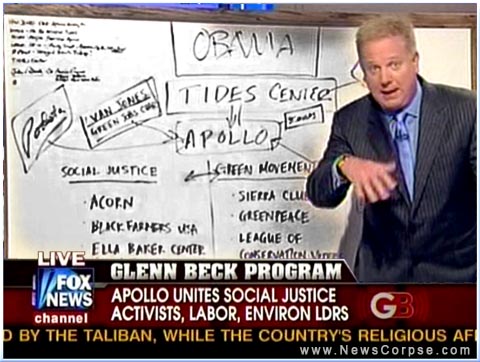
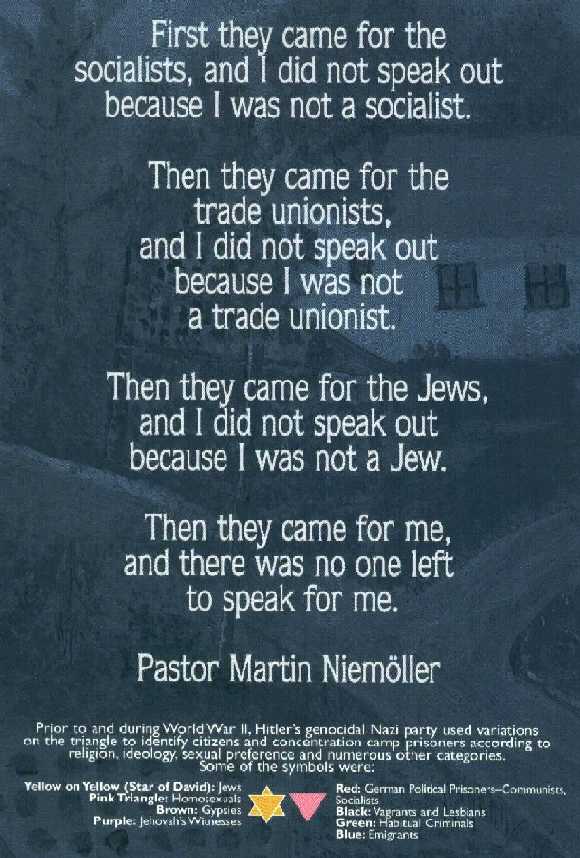
I see that Andrew Napolitano, a Fox News analyst referenced the infamous Martin Niemöller "first they came" statement regarding the TSA. Glenn Beck, in one of his daily rants against the dangers of progressive radicals, has also cited it. In these cases the quote has been trotted out to warn about the dangers of big government and progressivism. Slippery-slope arguments are perfectly fine political rhetoric, however, the constant analogizing of U.S. liberals to the Nazis, merits context about this quotation.

First, to the man who said it: Martin Niemöller. A conservative Lutheran minister who initially supported Hitler's rise to power,
Niemöller increasingly saw the Nazi regime as a danger that needed to be confronted. He began to speak out openly against the regime, and for that he was imprisoned in concentration camps from 1937 to 1945. His elegant words about the dangers of staying silent as different groups are targeted for persecution have become a profound and universal admonition.

That said, the quote is often misstated as referring only to Jews.
Professor Harold Marcuse at UC-Santa Barbara, whose expertise is in modern German history, has a very comprehensive website about the quotation and Niemöller. Based on that, I have placed below the most accurate version of it (emphasis added):

"First they came for the Communists, but I was not a Communist so I did not speak out.
Then they came for the Socialists and the Trade Unionists, but I was neither, so I did not speak out.
Then they came for the Jews, but I was not a Jew so I did not speak out. And when they came for me, there was no one left to speak out for me."

Yes, the people who they "first came for" were, in fact, Communists, socialists, and trade unionists. The reasons are fairly straightforward: the German left, particularly the more moderate (but still quite progressive) Social Democrats, were Hitler's chief opponents. On a practical level, they represented alternative sources of political power that Hitler needed to eliminate to assert complete control.

Ideologically, the situation is somewhat more complicated. Fascism is a frankly weird ideology, melding some left-wing ideas (a disdain for capitalism) with other views more associated with the political right (hyper-nationalism and militarism).* I hesitate to call Hitler "right-wing," but it is definitively the case that most everyone who identified as "left" in Germany opposed the Nazis.

Of course, Beck and his fellow travelers cannot be bothered with such details. Speaking of Beck however, remind me again, who gives regular speeches denouncing socialism and social democracy and insisting they must be combated vigorously? And who sees unions as a malignant force in our society? Well, let's see, Glenn Beck and . . . Adolf Hitler! Why, could it be, that Glenn Beck is a Nazi sympathizer?

Actually, no. Just because he opposes some of the ideologies that fought Nazism does not make him a Nazi. There were conservatives (like
Niemöller) who stood up against the Nazis too. But sadly, such historical complexities apparently do not fit into sarcastic, ill-informed rants made in front of a chalkboard.
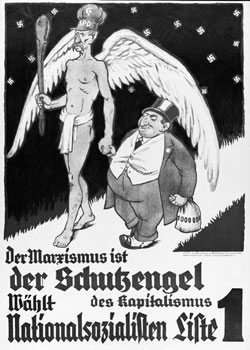

*Hopefully this image gives a sense of how difficult placing the Nazis on the conventional ideological spectrum is. This is a Nazi election poster from 1932, portraying Social Democrats and capitalists as part of the same evil; it states (paradoxically) that "Marxism is the patron saint of Capitalism."

Tuesday, November 23, 2010

A Very Hayekian Thanksgiving?

This past Sunday’s New York Times points to yet another battlefield in the war of historical interpretation that is one of many fronts in our current ideological conflict. This time, it is the stories of the initial failures and later successes of the Jamestown and Plymouth colonies that serve as convenient fables proving the universal superiority of the pure free market. Specifically, conservatives attribute these colonies’ initial hardships to the fact that “the first settlers were actually early socialists. They realized the error of their collectivist ways and embraced capitalism, producing a bumper year, upon which they decided that it was only right to celebrate the glory of the free market and private property.”

What this example demonstrates is that any historical episode can be employed to “prove” a political perspective’s assertions, as long as the analysis is kept generalized. Such as by claiming that Jamestown and Plymouth actually are evidence that markets lead to disaster and only heavy state intervention provides stability and growth. Observe.

In the case of Jamestown, a strong argument can be made that the obsession with profits over other community needs characterizing the colony's early years (as well as a conservative view on how capitalism best functions) caused many of the colony’s troubles. In its first decades, Jamestown was run by the seventeenth century version of a multinational corporation, the Virginia Company. As historian Karen Kupperman (who is interviewed in the article) describes, the drive for profit pushed by the company meant that “much attention was diverted from building essential infrastructure to the continuing effort to find those indispensable ‘marchantable commodities.’” To take one concrete example, the initial colonists sent by the Virginia Company included numerous individuals expert in mining and metallurgy, but fewer who knew about agriculture.

In fact, the private management of Jamestown proved so problematic that in 1624 the colony underwent a seventeenth century version of nationalization, becoming a royal colony administered directly by the crown. This change happened after a government investigation uncovered evidence of severe mismanagement by the Virginia Company, even as its directors collected scandalously large salaries. Jamestown's transformation to a royal colony had beneficial results; in its aftermath began a “great period of varied production” that included everything from brewing to gun making (oh Virginia).

So Jamestown proves the universal superiority of state-run institutions over private, profit-seeking ones? Hardly. There are of course state-run institutions that run with great efficiency. There are also private businesses that run competently. The crises of Jamestown's early years had as much to do with disease and bad weather as it did with how English colonists organized themselves economically. And while I cannot speak to the details, I would expect that studying a seventeenth-century royal colony can tell you as much about modern day state-run enterprises as studying radical Republicans circa 1866 can tell you about radical Republicans today (ie., a little, but not much).

How about Plymouth? The Times article notes the central thesis for conservatives lies with the changes in land distribution. Initially, Plymouth’s farm lands were communal (which proved disastrous) and then they were divided into individual plots (which proved successful). Not being an expert on this, it sounds plausible; collective agriculture has certainly seen its historical disasters, and a lot depends on the dynamics of the community. The article quotes scholars who note (as could be expected) a number of other factors were at play (such as the Pilgrims becoming better farmers with time). Furthermore, what the conservative account ignores is that, while the Pilgrims may have given up on communal ownership, they maintained policies around land to promote general social welfare. Looking over the right-wing “Great Thanksgiving Hoax” site, one is hard pressed to find the portion of Plymouth governor William Bradford’s decree on creating individual land ownership that also required farmers to set aside some of their food for those who needed it; “a portion for public fishermen &c. who could not work” to quote directly. Apparently even privatization could not kill welfare socialism.

As always, the take-away message is that simplified history does a disservice not only to understanding the past, but also for interpreting the present and building for the future.

Wednesday, October 27, 2010

The 1830s Cartoon That Explains Today's Tea Party

Sometimes a historical document comes along which seems to reach across the centuries and achieve an almost timeless resonance. While doing research on the English anti-slavery movement I came across such an item in the form of an early 1830s political cartoon satirizing the English anti-slavery movement. What is striking is how, in one image, it encapsulates the complexities of a strain of conservative populism that has been an important force in U.S. and global politics (albeit in dramatically different ways) for a long, long time.

First, here is the cartoon in question (clicking on the link you can go to a page that allows for zooming in closer on the image):

Before going into detail, a few more words about the idea of "conservative populism." As Michael Kazin, one of the leading scholar of the topic, explains in his book The Populist Persuasion, conservative populism premises itself on the defense of the great "middle" of American society. These are the people and families who "paid America's taxes, fought its wars, and upheld the ideal of economic independence." While not by definition white, throughout U.S. history and to this day, that middle has, sometimes more expressly than others, been defined as white Americans.

The spark for initiating populist uprisings comes when the middle is threatened by forces of insecurity, whether they be direct material challenges to the "middle" economically and politically or focus more on abstract notions of identity (social, racial, political, etc). What distinguishes right-wing populism lies in its emphasis on threats from both "above" and "below." Progressive and left-wing populism focuses overwhelmingly on dangers from above, particularly emanating from the business classes. As Kazin describes, conservative populism sees both threats from "above," consisting of "a tiny elite that lived off the labor of others," along with a related danger from below, made up of "a larger group whose poverty seemed perpetual and whose behavior appeared servile, undisciplined, and childlike."

All of these themes are expressed in this one image. On the left side we find a hard-working, white middle or working class English family, crushed by taxation and debt. The man's attentive wife laments their situation, questioning "What [probably meaning "why] must an industrious and honest man starve in a country like this?" Meanwhile, the man decries his situation, bemoaning the fact that his plight (and of those like him) does not receive the same care and attention from elites as does that of the slaves. He notes that people like himself can get no help, "unless I draw a cart harnessed like a beast and get fed by the Parish." Meanwhile, the obviously affluent abolitionist chides the white workers for not recognizing how well off they are, and for not caring more deeply about the plight of the slaves. Finally, to the right, a group of slaves merrily dance in the background and those foreground seem both slothful and by no means in dire straits (they are well-fed and clothed for example)

Anything seem familiar? It is all here: the snide, wealthy liberal elites who care more about the undeserving (and racially different) than they do about the dignified common (read: white) middle and working classes. The beset upon, earnest white working-class family struggling to be independent and productive. And finally, in the image of the "happy slaves," the racialized "other" who represent social inferiors, yet who still receive all of elite society's sympathy and assistance.

All of this I believe is present in the current conservative movement. Besides the obvious racism of some elements of the Tea Party, for much of the movement there seems to exist an undercurrent of resentment not totally unlike the cartoon above. This feeling, for example, helps explain how so many Tea Party activists can sincerely proclaim the need to roll back government (even to pre-New Deal days), while seeing no problem with big government programs like Medicare and Social Security. The problem is not the existence of such programs, but the fact that to the Tea Party, the liberal elites care more about helping those who do not contribute to society than looking out for the interests of the majority. Take this exchange from Matt Taibbi with several Tea Party activists (bolded text is my emphasis):

"I'm anti-spending and anti-government," crows David, as scooter-bound Janice looks on. "The welfare state is out of control."

"OK," I say. "And what do you do for a living?"

"Me?" he says proudly. "Oh, I'm a property appraiser. Have been my whole life."

I frown. "Are either of you on Medicare?"

Silence: Then Janice, a nice enough woman, it seems, slowly raises her hand, offering a faint smile, as if to say, You got me!

"Let me get this straight," I say to David. "You've been picking up a check from the government for decades, as a tax assessor, and your wife is on Medicare. How can you complain about the welfare state?"

"Well," he says, "there's a lot of people on welfare who don't deserve it. Too many people are living off the government."

"But," I protest, "you live off the government. And have been your whole life!"

"Yeah," he says, "but I don't make very much."
It is essentially the same message as the cartoon: I deserve assistance because I am a model citizen, yet the elites who spend our taxes and have the power in society spend all their time helping the undeserving "other."

How do we deal with this? In future posts I hope to talk more about these racial dimensions. I should note that this comparison is not supposed to dip into territory somehow suggesting the Tea Party is pro-slavery. Nor do I think most of the movement is racist, not in the way most people still think about that term. Having a more honest dialogue about racism could be a small part of the solution. Then there is the issue of making a populism which unites people more than it divides them. That my friends, represents the ultimate question (and thus one I will try to pick at in some small way, another time).

Wednesday, October 20, 2010

Anti-slavery Electioneering

With all the talk about special interest group politics (damn that "Professional Left"!) it's worth pointing out that "special interests" have also contributed to some of the brighter moments in human history and that the dirty work of politics can achieve real accomplishments.

Take the poster below. As quick context: In 1832, after almost fifty years of campaigning the English anti-slavery movement was on the cusp of achieving the emancipation of all slaves in the English empire. While suffrage was very constricted in England, some people could vote, and professional anti-slavery organizations and citizen committees worked to elect pro-abolition candidates and punish those whose who stood in their way. This campaign also built on momentum caused by the so-called "Baptist War," a slave revolt in Jamaica which is widely seen as hastening emancipation by only further revealing the utter brutality of the slave owners and the instability of the slave system in the British Caribbean. Slavery would end in the empire two years later with the passage of the Slavery Abolition Act of 1833 (a bill that was in many ways deeply flawed, but still a major step forward for human freedom).

Friday, September 24, 2010

The Battle to Claim the Founders, Part 105896

Ron Chernow's piece in the New York Times today about the relationship (or lack thereof) between the Tea Party's views and the thought of the founders is well worth reading. The sections detailing debate over different interpretations of the Constitution are really fascinating (I did not realize just how quickly arguments over how "strict construction" emerged!) That said, Chernow's piece contains some slightly puzzling assertions. Most problematically, he writes as if clear lines of lineage exist from the two original political parties in the U.S., the Federalists and Republicans, to our modern day political ideas and parties. For example, here is Chernow on Jefferson and the Tea Party:
Jefferson and his Republicans (not related to today’s Republicans) advocated states’ rights, a weak federal government and strict construction of the Constitution. The Tea Party can claim legitimate descent from Jefferson and Madison, even though they founded what became the Democratic Party.
This is unfortunately what happens when you take general philosophical ideals expressed in the past and wrench them out of their specific social, economic, and political context. It is true that Jefferson and Madison believed in concepts such as "weak federal government." The critical political experience in their lives up to the point of the revolution had been dealing with an authoritarian British government which clamped down severely on independent governance. Yet, that does not necessarily translate into saying that Jefferson's reasons for advocating small government bear no difference that those espoused by the Tea Party. As I wrote about in a previous entry, Jeffersonian opposition to large government had much to do with the fear that a strong federal state would employ its power to maintain and expand the power of wealthy interests (including private businesses), at the expense of independent farmers and working people. Not exactly the philosophical underpinnings of modern conservatism in the United States.

Furthermore, Chernow seems to imply that Washington and Hamilton represent the fore-bearers of American liberalism; after all they "espoused a strong federal government, led by a powerful executive branch, and endorsed a liberal reading of the Constitution." Yet, such a reading seems to fall into the trap that if conservatives are for "small government" philosophically, then liberals must be for "big government." Hamilton's desire for big government came in large part out of a desire to create a strong, imperial state and to promote the development of large enterprises and businesses. While progressives do not categorically oppose such concepts, philosophically they see a strong state as a tool to help the marginalized in society and provide a check on powerful private influences. Try pairing that with a key Hamilton statement on his vision for the new government and society:

"All communities divide themselves into the few and the many. The first are the rich and well born, the other the mass of the people . . . The people are turbulent and changing; they seldom judge or determine right. Give therefore to the first class a distinct, permanent share in the government. They will check the unsteadiness of the second, as they cannot receive any advantage by change, they therefore will ever maintain good government."
Chernow's piece and any similar ones are incredibly welcome to creating a more historically accurate and complex political dialogue. What I would merely propose is that when we talk about the founders in today's politics, let's render them (to a realistic extent), the complexities of their views. One can find relevant political ideas not only from the "founding fathers," but from the slaves, working men, women activists, and so many others who forged the nation. But we should not pretend that any of us are their direct and unique descendants.

Sunday, September 19, 2010

At least no one has suggested this yet...

Important elements in the conservative movement and Republican Party have not exactly shown the greatest compassion for the unemployed during our current Great Recession. Much of the rhetoric has focused on implying that the unemployed are "lazy" or just not looking hard enough for jobs. Such rhetoric has a long history, but fortunately today's conservatives have steered clear of some of the extreme demands made in the past to further immiserate the unemployed. This was not the case during the Great Depression.

In 1934 a conservative business organization, the New York State Economic Council, put forward a stunning proposal. The organization had been formed as an anti-New Deal coalition headed by former Attorney General (under President Taft), George Wickersham. As historian Alexander Keyssar describes the NYSEC, it was an "influential voice urging lower taxes and reduced government expenditures to promote business recovery; it also opposed 'compulsory' unemployment insurance, denounced the American Federation of Labor as 'un-American,' and recommended the passage of laws outlawing general and sympathetic strikes."

Sounds a bit familiar, yes? However, the NYSEC's fears about government expansion moved beyond economic policies to focus on the electoral effects of the New Deal. Namely, the NYSEC saw government relief programs as potentially creating millions of dependent individuals, who would mindlessly vote for Democrats in order to get government monies. Thus, among the policy proposals they advocated included the "withholding from all persons receiving public unemployment relief the right of suffrage during the period in which such relief is being received." Officials with the NYSEC, reflecting the kind of fears later used about welfare recipients (read: African-American welfare recipients) regarding dependence on government monies creating voters loyal to one political party over another.

Fortunately, the proposal went nowhere. And if anything, perhaps such examples can help moderates and progressives breath a sigh of relief: we've had nutty ideas in the body politic before, but so far (more or less), the republic seems to have survived.

Monday, September 13, 2010

Three Random Thoughts on D'Souza

Dinesh D'Souza's cover article for Forbes (lovingly seconded by Newt Gingrich, who, on behalf of all people who have or are working to get U.S. history PhDs, I apologize for), so overflows with shoddy arguments that there's not really time to delve into all of them. A number of great writers have already done the job of skewering D'Souza's faulty logic and I especially recommend Adam Serwer's brilliant post on how the piece fits into larger conservative arguments. That said, I have three fairly unconnected thoughts:

1) Not An Original Smear: The notion that a U.S. president bases his allegiance to some foreign ideology is by no means a new one. In fact, a long history exists of political opponents attempting to link their opponents to some foreign (and radical) ideology, thus discrediting them completely. One of the first victims of such attacks was Thomas Jefferson, who, particularly in his 1800 campaign, came under constant attack by Federalists claiming his allegiance lay with the French Revolution, not the American. One such controversy involved a 1796 letter Jefferson wrote to Philip Mazzei, in which he expressed concerns over the political path the fledgling nation had embarked under Federalist rule. The Federalist press rushed to imply that Jefferson had abandoned his loyalty to the U.S., with one key Federalist newspaper, the New York Minerva, printing excerpts of the letter and commenting that, "it seems hardly possible an American could be capable of writing such a letter." Ironically, Jefferson's letter to Philip Mazzei itself indulged in the same type of rhetoric, arguing that Federalist policies had created "in place of that noble love of liberty and republican government which carried us triumphantly thro' the war, an Anglican, monarchical and aristocratical party had sprung up, whose avowed object is to draw over us the substance as they have already done the forms of the British government." As one more example, some opponents of Abraham Lincoln viewed him as overly close with various European exiles in the U.S. who had been leaders in the famed 1848 revolutions in Europe, seeing their often strong abolitionist views as marking the entry of foreign notions into American politics.

2) Stop Pretending You Knew the Founders: In the piece D'Souza attempts to figure out "Obama's dream" and notes that "[it] is certainly not the American dream as conceived by the founders. They believed the nation was a 'new order for the ages.'" As I wrote about before, the claim that one's own opinions truly reflect those of the "founding fathers" remains one of the most persistent and frustrating memes in modern uses of historical example. The founding generation had a great diversity of opinion about the "American dream" and what American identity meant. Certainly, a Hamilton and a Jefferson didn't agree about what form the U.S. economy should take. And the slaves who fought for the pro-independence side most likely viewed themselves as "American," even if most of the founders did not. The same goes for women who lobbied for (and in New Jersey briefly won) suffrage and other rights, but were denied an equal place in U.S. society.

D'Souza also revives a conservative attack on Obama which accuses him of denying the existence of "American exceptionalism," calling into question his motivations for being president. Taking a look at the full Obama quote, this is at best a gross oversimplification. And it certainly does not mark a rejection of the founders. Obama's view of American exceptionalism is that there are a number of laudable and unique characteristics about U.S. culture and history. That said, Obama did not claim the U.S. to be empirically "better," rather noting that other nations have their own exceptional characteristics, and that together a better world can be built. Such sentiments clearly echo certain strains of thought and values from the revolutionary generation, especially those expressed in word and deed by Thomas Paine, who saw the U.S. as exceptional, but believed much of what was best about the U.S. could be spread abroad through an international struggle for liberty.

3. Read Some African History: D'Souza's term "Kenyan anti-colonialism" is rather amusing in its ignorance of African history (and I'm no expert). I get that he's using this as short-hand to refer to the larger, post-colonial move by many African and Asian nations, reflected in the 1970s push for a New International Economic Order, which challenged global economic structures with a far-reaching program of reform. However, Kenya was never a major participant in those movements and its development strategy in the late 1960s and onwards focused on inviting in foreign investment, not internal, state-led development. You know, the kind of policies D'Souza favors.

Monday, September 6, 2010

Labor on the Screen

In time for Labor Day here is a non-representative sample of four of my favorite on-screen depictions of organized labor from U.S. history:

(1) Matewan: John Sayle's account of the 1920 strike by coalminers in the West Virginia town of Matewan conveys better than any other film I've seen the lives, struggles and issues surrounding workers in the U.S. at the opening of the 20th century. The film digs not only into the relationship of workers and bosses, showing the extreme measures undertaken by companies to stop unionization, but also addresses how the racial and ethnic diversity of the U.S. (this was a time when being an Italian or a Pole or a Jew set one apart from the white Anglo-Saxon norm) played into labor's fights. A fascinating sequel is yet to be made depicting the West Virginia Mine Wars that the Matewan incident ignited. That conflict culminated in the Battle of Blair Mountain, where around 10,000 armed miners fought against private security forces, state militia and eventually federal troops (who even used bomber planes from World War I) in the largest insurrection in U.S. history since the Civil War.

Here's a key scene from Matewan that plays as an excellent (if slightly didactic) primer on race and labor, with a lot of resonance for today:


(2) Salt of the Earth: Of the films on this list this is certainly the forthrightly propagandistic. The film is based on a real strike by mainly Mexican-American workers against the Empire Zinc Company in 1951. Salt of the Earth has achieved a level of infamy because many of the key figures who made it were members or allies of the Communist Party and the union it examined, the International Union of Mine, Mill and Smelter Workers, was expelled from the CIO in 1950 for its leaderships' communist affiliations. Given the film's 1954 release, it suffered the full effects of McCarthyism, going largely unseen at the time of its release and only slowly becoming recognized as a classic of political film making. Most of the actors and actresses are non-professionals and in fact are the very people the story is based on. While partially worth viewing purely for its historical value, Salt of the Earth is also remarkable in its forthright feminism, as the union men learn to respect their female comrades (remember this is at least a decade before the "second-wave" feminist movement truly came into its own). Additionally, the portrait of conflicts between Mexican-American and "Anglo" workers carries obvious importance for today.

Here are the first ten minutes:


(3) Norma Rae: It's really too bad Sally Fields' "you like me" Oscar speech is better remembered than the message of Norma Rae. The film is somewhat similar to Matewan in its exploration of the tensions between an outside union organizer and the local workers. Based on the life of Crystal Lee Sutton and the campaign by the Amalgamated Clothing and Textile Workers Union to organize the J.P. Stevens company, a notoriously anti-union company based largely in the South (in Sutton's case, North Carolina). It's also an important film for delving fully into the added difficulties faced by women workers (who are now or soon will be the majority of union members) and by having a female protagonist it helps cut against the cinematic stereotype of union workers as burly, white men. Also a great film to see because of its focus on labor in the New South during the 1970s, a decade that's increasingly being recognized as pivotal to understanding our present, including the fate of workers in the U.S.

Here's the classic "Union" scene:


[Minor Spoilers Ahead]

(4)
The Wire, Season 2: In the show's second season we move from the inner city to the port of Baltimore and the trials and travails of a local dockworkers' union (which is closely based on the International Longshoreman's Association, that provided the inspiration for On the Waterfront). In particular, the season focuses on the efforts (legal and illegal) of the local's secretary-general, Frank Sobotka, to save his union and the decent life it has provided. The second season is sometimes seen as a detour from the main plot of the show, however thematically it is vital to understanding the modern U.S. In exploring why the drug trade proves so attractive to so many in the inner city, one must understand the impacts of deindustrialization and the failure to make the new, service heavy economy, one that produces not only jobs, but good jobs. The timing of deindustrialization is also critical for understanding the plight of so many inner city African-American communities. After World War II, many southern African-American communities increasingly moved northward to secure well-paid manufacturing work in a second Great Migration. Yet, they moved north just as those same jobs began to move south, as companies sought out less union-friendly locales, first in southern states and then overseas, leaving northern African-American communities without a strong economic base.

Put another way, what we see starting to happen with the hopelessness and turn to crime of Nick and Ziggy Sobotka is what happened to the parents and grandparents of Avon Barksdale or Bodie.

There's so much more to be said, but I'll leave it with this scene in which the police arrive at the union local's headquarters to serve subpoenas on several members. In response, Frank Sobotka delivers an impassioned speech (starting at minute 2:00) about the resilience of the unions in the face of problems caused by their own corruption, as well as attacks by business and government.

Thursday, September 2, 2010

MLK: Judge On the Content of His Actual Beliefs

Banalogies friend Seth D pointed me to this piece from the Moderate Voice, which honestly is best read as an Onion-esque parody of a "sensible" moderate position. The author, Rick Moran, seeks to find a reasonable middle ground between those who believe the Tea Party is the inheritor of the civil rights legacy and those who vehemently disagree. As Seth noted to me, Moran writes as if Martin Luther King Jr. were some ancient figure whose views on modern issues we can only speculate on. This allows him (without linking to any sources) to state, for example, that King "would have scoffed at the modern interpretation of 'social justice.'" Perhaps most ludicrous is Moran's attempt to make King out to be a skeptic of government interventions to achieve greater social justice, asserting that King would have opposed programs based on ideas of "positive rights" because he believed that "change would come only when the hearts and minds of Americans were turned from hate and that only through Christian love and charity."

This is not a matter of difference of interpretation; these statements are factually incorrect. Look at the demands of the March for Jobs and Freedom in 1963; among them are higher minimum wages and a "massive federal program to train and place all unemployed workers - Negro and white - on meaningful and dignified jobs at decent wages." When King was murdered in 1968, he was assisting with a sanitation workers' strike and building to the planned Poor People's March, which again demanded massive government intervention to end poverty.

Not only were King's views on policy clear, so were his politics. Let's take the movement's fight for voting rights. Most of the time, the struggle for full suffrage rights is discussed in a way that make the goals of the movement mainly philosophical. Thus, the main point of fighting for full suffrage rights was for African-Americans to be equal citizens to whites. While this was a vital element, King and the movement also saw gaining full voting rights as a pragmatic tactic towards larger objectives, as seen in his 1961 speech to the Transport Workers Union:

"The campaign to grant the ballot to Negroes in the South has profound implications. From all I have outlined, it is clear that the Negro vote would not be utilized in a vacuum. Negroes exercising a free suffrage would march to the polls to support those candidates who would be partial to social legislation. Negroes in the South, whether they elected white or Negro Congressmen, would be placing in office a liberal candidate, if you will-a-labor candidate. (APPLAUSE) No other political leader could have a program possessing appeal to Negroes."
How about King's views on conservatives? Well, right before receiving the Nobel Peace Prize in 1964, he gave a lecture that included comments on that year's presidential election, in which Lyndon Johnson crushed conservative champion Barry Goldwater. As Rick Perlstein and others have shown, the modern right in many ways came into its own with Goldwater's campaign and a direct line runs between the Goldwaterites and today's conservatism. Here's what King had to say about Goldwater and the right-wing movement of the day:
"Another indication that progress is being made was found in the recent presidential election in the United States. The American people revealed great maturity by overwhelmingly rejecting a presidential candidate who had become identified with extremism, racism, and retrogression. The voters of our nation rendered a telling blow to the radical right. They defeated those elements in our society which seek to pit white against Negro and lead the nation down a dangerous Fascist path."
A lot of history is open to interpretation and debate. Indeed it is often highly problematic to say what a historical figure would have said about current events. However, on the question of King and modern conservatism, there really is no question where he stood.

Wednesday, September 1, 2010

Still Forgetting Walter

I swung by the "Restoring Honor" rally on Saturday which attempted (as many have pointed out) to appropriate the legacy and meaning of the black freedom struggle for the religious right/Tea Party movement. As Saddam Hussein might say, such an assertion may represent the "mother of all banalogies." This is one of those cases where interpretations of history do not even come into play, we are talking simple facts. In this case, it is an indisputable truth that Martin Luther King, Jr. and the key figures around him were progressives and had strong leanings towards Scandinavian style social democracy or more radical forms of democratic socialism. The black freedom struggle had an important economic component, one which many in the movement felt could only fully be addressed by first winning civil rights, but certainly not only through such measures. Figures in the movement forthrightly identified as progressives and attacked conservative political figures and ideas. Really the only way to miss all this is to pretend (as so many seem to) that the entire message of the movement is summed up in King's "content of their character" line, even a reading of the rest of the "I Have a Dream Speech" showcases the importance King placed on poverty and power relations.

It was this sort of assertive amnesia which reached its zenith during a video tribute to King at the rally. The longest single image from that montage featured a slow-motion shot of King at the rally sharing a joke with Walter Reuther, whose birthday is today. Now, I didn't expect people to recognize Reuther, but still the irony was overwhelming. Reuther was then president of the United Auto Workers, perhaps the most powerful (and one of the more progressive) unions in the U.S. at the time. Reuther and his compatriots, while a pragmatic lot, retained a vision of society that much more closely resembles the nightmares Beck sees in Obama's policies than in the reality of the current administration. They wanted to transform the U.S. economy through social insurance programs and economic planning to ensure full employment, good jobs, and even sustainable development.

It was these very views that helped cement an alliance (albeit one which strained and even broke at points) between the black freedom struggle and the labor movement. To cite one concrete detail, a good portion of the funding for the logistics of the August 28, 1963 rally (including the sound system which brought "I Have a Dream" to the world) came from the UAW's coffers. If Glenn Beck wants to be an heir to this he can feel free, but I have my doubts.

Tuesday, August 31, 2010

Wall Street and the Founding Fathers

Yesterday's New York Times provides a nice, anecdotal (and I mean that in a good way), look into the worldview of Wall Street businesspeople who supported Obama for president, but now are turning on him over financial reform and his rhetorical corporate America. Of particular note for this blog is the contention by hedge fund manager Daniel Loeb that “[a]s every student of American history knows, this country’s core founding principles included nonpunitive taxation, constitutionally guaranteed protections against persecution of the minority and an inexorable right of self-determination."

Statements such as these go to what should be a core "banalogical rule": if someone is claiming their political views are the direct inheritance of the founding generation and its principles, it's likely they're oversimplifying. What makes the Founding Fathers a perpetual source of fascination and debate is that they were extremely complicated and even contradictory thinkers. Let's take as an example Thomas Jefferson, given that some of his pronouncements found themselves recruited for the complaints of businesspeople on Wall Street. Here are two Jefferson quotes on economics:

(1) "Having always observed that public works are much less advantageously managed than the same are by private hands, I have thought it better for the public to go to market for whatever it wants which is to be found there; for there competition brings it down to the minimum of value." --Thomas Jefferson to William B. Bibb, 1808. ME 12:107

(2) "Money and not morality is the principle of commerce and commercial nations... Justice, honor, faith, must yield to the necessity of keeping themselves in place. The question whether a measure is moral is never asked, but whether it will nourish the avarice of their merchants."
--Thomas Jefferson to John Langdon, 1810. (*) ME 12:376

Do those two quotes make sense in the modern left-right context? Potentially, but not easily. However, in the late 18th and early 19th centuries, in an era when merchants and large-scale businesses were only beginning to emerge, they did. Taking Jefferson and his fellow republicans as a case study, we find that the views on economics debated by the founding generation mixed a variety of viewpoints that today we associate with left and right into patterns very different than today.

Jeffersonians certainly expressed some views which fit in well with conservative politics, as seen in the first quote. Jefferson was a strong proponent of free trade and territorial expansion to provide more lands for production. Support of such policies also led Jefferson to promote an aggressive foreign policy aimed at assisting U.S. export interests, something associated with both political parties, but often criticized from a progressive perspective. Jeffersonians also opposed government subsidies to businesses, seeing them as helping to breed monopolies which undermined a real free market system. One can also find in Jefferson's opinion on the constitutionality of a national bank his fears about excessive federal government power being employed in regulating commerce.

At the same time, Jeffersonians expressed grave doubts about merchants and manufacturers, questioning their loyalty and very morality, as well as criticizing wealth inequality as a major threat to nation and justice. As one example, take this quote from James Madison, who, in speaking about the future of the nation, urged that laws be passed "which, without violating the rights of poverty, reduce extreme wealth to a state of mediocrity and raise extreme indigence to a state of comfort." To those who might find the part about property rights a counter, one can find concrete expressions of Madison's view in places such as his support for a wealth tax in Federalist No. 21. Jefferson similarly advocated versions of progressive taxation and worried constantly about the "misery" wealth inequalities created, as well as the dangers to a fair republic they represented. As the modern corporation began to take form in the early nineteenth century, Jefferson grew increasingly concerned and his writings showed at least as much antipathy to early "big business" as to "big government." As an example, in 1816 he declared that "I hope we shall crush… in its birth the aristocracy of our moneyed corporations."

What to make of this? Well, to put succinctly, Jeffersonians feared concentrated power - they believed a nation of independent farmers (white ones of course, slaves inhabited essentially a different universe), neither particularly wealthy nor poor, mostly unrestrained by government but also protected from the greed of merchants, represented the most just path for the future. Try grafting that into our modern, post-industrial national situation.

That said, I do not mean to imply that the thoughts of the founding generation bear no relevance on today. Many of the larger dynamics they faced are still issues today. Let's just remember they were complex people in a different time before enrolling them into today's fights.

Saturday, August 14, 2010

"Business, always business": The Wire and the History of U.S. Capitalism

WARNING: SPOILERS AHEAD

The Wire
is that rare cultural creation that is even better than the overwhelming praise would suggest. The show's explorations of urban inequalities, the failures of institutions, and the ambiguities of how people survive (and don't) are truly epic, yet manage to stay grounded in the experiences of its many and sharply drawn characters. Central to the show however is the emphasis David Simon, Ed Burns and co. place on the failures of the current economic model to provide opportunity and decent lives for so many people. One only need to watch the tragic story of Frank Sobotka, head of a local dockworkers’ union, to get a sense of Simon’s deep understanding of the way, particularly since the Reagan presidency, that the "profits before all" economic model has bred an increasingly unequal and in many ways dysfunctional society.

One of The Wire's main arguments centers on how deindustrialization and the failure (as of yet) for the transforming economy or our political system to ensure some matter of economic security for everyone (especially people of color in urban centers) contributes mightily to creating the array of issues associated with illegal drugs. Ironically (as the creators take delight in pointing out), although the drug trade exists outside many societal norms, it is at the same time as thoroughly capitalistic an enterprise as selling footwear or electronics. One can imagine a world in which, if they were legal, some of the despised drug kingpins might be hailed as innovative CEOs.

Building on the idea that the depictions of the drug gangs can teach us about business dynamics, I would like to suggest that watching The Wire contains lessons not only about the present, but also the past. As I plan to help show in a series of posts, watched at a metaphorical level,The Wire presents a solid introduction to the history of how organizational structures and the worldviews of U.S. business have transformed repeatedly over the past hundred years. That may sound a bit outlandish, but given that one of the leading scholars of the urban crisis in the United States, William Julius Wilson, is teaching an entire class based on the show, perhaps not. I'll have more to say about this, but for the moment, here's a sneak peak of what's to come:


1) "Games beyond the game": Avon, Stringer, and the Rise of the Corporation

2) "Making sense of this game": Prop Joe, Stringer, and the Post-War "Consensus"

3) "I ain't been one for meets no how": Marlo and the Robber Barons

4) "And of course, I'm not even Greek": The "Greeks" and the Multinational Corporation

Thursday, August 5, 2010

Gay marriage opponents and the USSR

Maggie Gallagher, Chair of the anti-gay marriage group the National Organization for Marriage (NOM) called the overturning of Prop 8 by activist leftist judge (who in fact was a Reagan appointee recommended by Ed Meese) a "Soviet" style takeover. Which makes some sense as a metaphor but also raises a funny little historical issue. See, I know the specter of communism is supposed to be an indictment of liberalism, but if one looks at the actual policies of the U.S.S.R., they were actually much more in line with right-wingers on homosexuality. Starting in the Stalinist era, homosexuality was in fact illegal under Article 121 of the Soviet criminal code which made sexual relations among men punishable by a five year prison term. Communist propaganda not only in the USSR, but throughout Eastern Europe and also in Cuba (though its policies have dramatically shifted in more recent decades) depicted homosexuality as one more negative symptom of capitalism, painting it as a form of "bourgeois decadence." While all of this is certainly much more harsh than what NOM would like to see, perhaps in this area, Ms. Gallagher should rethink what a "Soviet-style" takeover would really mean.

Wednesday, July 21, 2010

FDR Would Appoint Elizabeth Warren

The historically-minded debate over "is Obama's presidency progressive?" seems the perfect topic for this blog, so it’s long past time I jump in. To summarize: On one side are those who look at Obama so far and see missed opportunities, political cowardice, and a presidency whose ideological marker seems more mushy third-way then strong progressivism. Obama’s failings often find themselves unflatteringly contrasted to the strength and principle that Roosevelt or Lyndon Johnson brought to achieving their legislative aims. Perhaps the most cited example of this involves contrasting some seemingly weak-willed, overly nuanced Obama talk about big business with the fire of Franklin Roosevelt's "I welcome their hatred" speech in Madison Square Garden in November 1936. One could also note the extraordinary pressure Johnson often brought on members of Congress to vote his way on particular bills or even Roosevelt’s noble (though somewhat disastrous attempt) to purge ultra-conservative Democrats with more progressive ones in the 1938 midterm elections.

The other side, best represented by Michael Tomasky in his piece, "Against Despair," urges progressives to take a deep breath and look at the full records of Roosevelt and Johnson. Rather than liberal stalwarts, Tomasky and writers such as Eugene Goodheart, note the many compromises and failings of both Roosevelt and Johnson in fighting for progressive goals. One need only look at the essential exclusion of African-American workers from the original Social Security program (a compromise to Southern Democrats) to see that high progressive principle was not the only pillar Roosevelt stood upon. Overall, as Tomasky describes in writing about FDR, both his presidency and Obama’s provide clear demonstrations of the “difficulties inherent in trying to effect change, the readiness to accept half a loaf, and the regular reassurances sent to the moneyed classes that the liberals hadn’t taken over the candy store.” He then goes on to detail the historical and structural barriers Obama faces that FDR and LBJ did not: the ballooning of the filibuster, the evaporation of bipartisanship, the weakening of social movements like labor, etc.

Overall, I tend to agree with the tenor of Tomasky and others who, looking at the history, find that "all this has happened before and will happen again" so to speak, a subject I hope to come back to later. For now however, let’s focus on one area where a historical perspective does not place Obama in as good standing as an FDR: diversity of advisers.

Generally, both camps have ignored the specific issue of advisers when examining Obama historically. Goodheart does cite Obama's promotion of a "team of rivals" as a positive characteristic of his administration. At a forum about his article, I had the opportunity to ask Tomasky about Obama's lack of progressive high-level appointees; his response focused on the fact that Roosevelt’s cabinet did not overflow with aggressive liberals, but rather counted among its number several conservative appointees, such as Hans "let's cut the deficit during a depression, what could go wrong?" Morgenthau.

The point however is not to expect that Obama’s policy team would be totally culled from the precincts of The Nation or the Economic Policy Institute. Rather, where some disappointment with Obama in historical context seems merited revolves around the lack of an ideologically diverse set of core advisers. I differentiate this from his cabinet in general; on that count Secretary of Labor Hilda Solis is an obvious progressive and strong cases can also be made for many on the energy and environment team such as Stephen Chu or Lisa Jackson. Thinking specifically about the economics team, the question though is how much he listens to those outside the Geithner-Summers pole of opinion. Solis for example has dramatically transformed the Department of Labor into a force siding with working people as it should (we have Treasury and Commerce Departments to look after business after all). But does Obama listen to her about larger economic matters? How much input did Solis have in health care or financial reform? Or Jared Bernstein for that matter?

Now, one could easily fit Tomasky and co.'s overall argument on to the appointee question: with the absurd filibuster continuing as a sort of tragicomical block on reform, what good would some more progressive advisers have? Perhaps none. At the same time, who knows what political and policy options currently receive scant consideration because there are not forceful advisers to make their case. As William Leuchtenburg and others have long argued, Roosevelt did not want to expend political capital on the National Labor Relations Act, although he did not fundamentally oppose the idea. It took the great upswell and pressure of organized labor to provide the space for people Roosevelt trusted (primarily then New York Senator Robert Wagner) to lobby him personally and bring the bill over the line. Similarly, it was the relentless lobbying by Frances Perkins that helped push Roosevelt to embrace and fight for the creation of Social Security. Are there similar situations for Obama? Perhaps regarding a public option or a different sort of jobs bill?

This is where Elizabeth Warren comes in. I don't know how good Obama and her relationship is or how much weight he places on her opinions. However, we do know that Nancy Pelosi takes Warren seriously, as do several key Senators. The fact that in the past she and Geithner have sparred to me is a big PLUS; they're both smart people and her presence could bring some needed variety and yes "rivalry" to Obama's team. Also, like strong progressives in past administrations, she can count on an independent public constituency (in some ways akin to Perkins, whose previous labor advocacy work gave her key allies in civil society) willing to support and assist her, one she has helped build through media appearances, including several with Jon Stewart. Certainly there are other good nominees who could run the agency competently. Warren however, would be an outsized voice, someone who could spark debate and maybe even cause some trouble from time to time. And history does show that it is often the healthy annoyances that catalyze real accomplishment.

Thursday, July 1, 2010

Woodrow Wilson's Leftist Lawyer, Part I

It has been one of the more idiosyncratic aspects of Glenn Beck’s version of reality that Woodrow Wilson has become one of its central villains, with our 28th president also serving as the father of the "cancer" that is modern progressivism. Suffice it to say, no, Woodrow Wilson did not invent progressivism. Wilson fits in no easy box (one of the reasons historians keep writing about him), but certainly he embodied both progressive and conservative (even reactionary) views. Wilson certainly has many detractors on the left, who, while perhaps not as vitriolic as Beck, have found much to criticize him for, ranging from Wilson's often hypocritical foreign policy in which rhetoric (and some action) seeming to challenge imperialism cohabitated quite nicely with often imperial policies, his deep racism which saw expression in the segregating of the federal government, and his unforgivable suppression of civil liberties during World War I. Perhaps because of this, Wilson’s legacy as a sometimes quite progressive president have been sidelined, but are worth looking at. To tie these to my previous post about Beck's obsession with Obama's "radical" advisers, I want to look specifically at how major pieces of Wilson's legacy are due, in part, to the work of a "radical" adviser, who helped make the U.S. a fairer nation for the wage-earning masses.

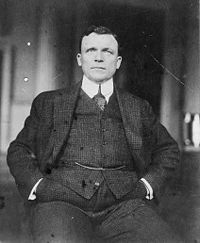
And with that, let us now turn to one of the great unsung heroes of the Progressive Era: Frank P. Walsh. A brilliant labor lawyer from Kansas City, Walsh served as a steady ally of Wilson in the 1912 campaign. This work caught Wilson's attention and led him to push for Walsh to chair the U.S. Commission on Industrial Relations (USCIR), a congressionally appointed body tasked with investigating the problems of labor in the new industrial economy (a commission, it is worth pointing out, created because of organized citizen pressure). Walsh devoted himself completely into the USCIR's work, often stirring up great controversy as its investigations proceeded. Among its most impressive features was the the set of witnesses the USCIR heard from, which consisted of a range of views one rarely sees invited into mainstream dialogue. Coming before the commission was everyone from Industrial Workers of the World founder "Wild Bill" Haywood to the grand industrialists such as John D. Rockefeller and Andrew Carnegie. In a rather surprising turn of events, the members of the USCIR, representing a variety of interests, disagreed with each other on the final report so vigorously that they issued three separate reports! The most important of these however was Walsh's, which also advanced the most radical analysis and recommendations. With exhaustive documentation, Walsh's USCIR report gave a greater legitimacy to the struggles of workers in a time when unions were in many ways still a rogue institution. Walsh minced no words in the report, stating that "the basic cause of industrial dissatisfaction . . . .[is] the fact that the workers of the nation, through compulsory and oppressive methods, legal and illegal, are denied the full product of their toil." He called for unions to be given the right to organize and for the society to embrace the idea that "political freedom can only exist where there is industrial freedom [and he wasn't talking about deregulation], political democracy only where there is industrial democracy."

Before discussing Walsh's further work with the Wilson administration, it is worth taking a moment to comment on where Walsh stood ideologically. While his politics are somewhat hard to describe, he certainly stood on the left end of progressivism and showed at least a comfort with, if not outright support of, socialist ideals. In a letter to Eugene V. Debs, the perennial Socialist Party candidate and hero of American radicalsim, Walsh approvingly quoted one of his staffers' summary of the USCIR report, that, “[a]ccording to this report, Eugene Debs was right, and his only mistake was in being twenty years in advance of the times.” Walsh also maintained a friendship with the renown anarchist Emma Goldman, including providing legal assistance to her. Goldman felt sufficiently ideologically compatible with Walsh to call him in her memoirs a "radically minded man." Yet, Goldman also recognized the limits of Walsh's radicalism, particularly in his close relationship not just with Wilson, but with the Democratic Party, and in the next sentence after noting his radicalism she goes on to accuse him of "political blindness and social muddle-headedness." Walsh's desire to remain connected to the Democrats and the mainstream led him away from some of his more progressive stances, as in his support U.S. entry into World War I, despite having identified himself as a pacifist. Perhaps Walsh himself best expressed the seemingly contradictory relationships and positions he found himself in when he commented to feminist activist Doris Stevens that, "I hate like hell to be so respectable."

In part 2 I will discuss Walsh's involvement in helping set the first real federal labor policy through his service on the National War Labor Board.

Sunday, May 23, 2010

Is Rand Paul an NAACP Member?

I don't have anything particularly original to say about the Rand Paul/Civil Rights debate, but one thought has crossed my mind. A number of folks have written about Rand Paul as fitting into the Barry Goldwater conservative mold, including in his reasons for showing, hesitation, about the Civil Rights Act of 1964. Rand's defenders do this in good part to disprove accusations that he is racist. To which I would ask: what has Rand Paul done to fight racism?

Here's the issue: to oppose federal actions/regulations to combat racism and claim that one opposes racism, it's important to show that you can show that people will take private initiatives to combat this societal cancer. While Barry Goldwater's record is by no means perfect on that, his background indicated that the idea of private action was not just a theoretical counterargument. Goldwater was a member of the Phoenix chapter of the NAACP, and not just a passive dues payer; he actively worked for desegregation, overseeing the process in his family's department stores, as well as while serving as chief of staff of the Arizona Air National Guard.

Were such efforts enough? Of course not, but it at least suggested that the libertarian critique against civil rights legislation emerged from real ideological differences, rather than as a cover for ultimately racist views. I would say that modern "Goldwater" Republicans would do well to heed that lesson if they want to be taken seriously, but we're sadly long passed the point where people care about being taken "seriously." Well, except in the DC "serious way" which means moderately liberal social values, along with a pro-bombing and entitlement cutting agenda elsewhere. Yargh.

Wednesday, May 19, 2010

Glenn Beck Has a Point About the Left


Glenn Beck Has a Point (Part I in a series)

Yeah, you read that right. While Glenn Beck’s version of the past, present, and future has been well analyzed (and challenged) elsewhere, I would like to address one strain of his critique from a slightly different angle. For anyone who’s watched Beck’s show (or seen Jon Stewart’s parodies of it) the sight of Beck scrambling around various blackboards, drawing out the nefarious connections between far-left radicals and the Obama administration are as familiar as the morning commute. Often such connections are, at best, overblown and mostly exist as fantasies easily discounted or disproven. However, Beck’s insistence that radicalism has seeped into the policies and politics of past U.S. presidents actually bears some weight (though not as much for the Obama administration, which, in my opinion, could benefit from some more heterodox, left-of-center voices having the president’s ear). Democratic and progressive presidential administrations have been influenced by more radical actors in this country, and that has often been for the good of the U.S. While there’s a long history of radical movements making demands on the government, I would like to focus on one aspect of this relationship: the role of individuals who had (or continued to) travel in more radical circles who ended up becoming key influences on or members of past presidential administrations. This has been a specific fascination for Beck, visible most infamously in his campaign against presidential adviser Van Jones.

Radicals in the White House

In the next few posts I will explore a few “radical” figures who have become members of past administrations and used those perches to fight for social change. First, it is worth saying a few words about such individuals more generally. What do I mean by saying there have been “radical figures” in the White House? Primarily these have been individuals who have been appointed to various commissions, agencies, or cabinet posts whose political beliefs and experiences were forged (at least in part) through encounters with left-wing ideas and groups (the Socialist Party for example). Contra Beck, most of these individuals, by the time they reach an administration job, have moved towards more “moderate” positions (though not always) and such figures invariably hold very pragmatic views about making social change (otherwise they would not have the desire or ability to work for a U.S. president). Even with these caveats, their goals have often been thwarted and their influence should not be overstated. Despite the many obstacles in their way however, some of the key legislative and political progress on labor rights, social insurance, and civil rights in the U.S. are partially because of such figures.

So stay tuned; first up we'll add more kindling to Beck's Woodrow Wilson hate fire through a look at attorney and labor champion Frank Walsh.