Showing posts with label radicalism. Show all posts

Wednesday, May 19, 2010

Glenn Beck Has a Point About the Left


Glenn Beck Has a Point (Part I in a series)

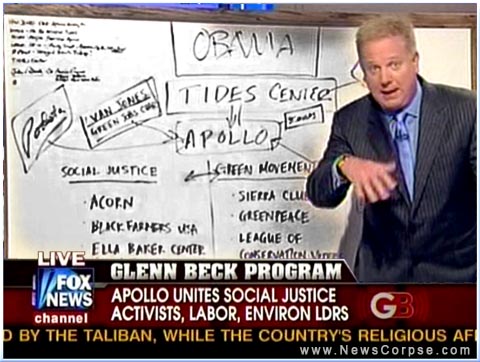
Yeah, you read that right. While Glenn Beck’s version of the past, present, and future has been well analyzed (and challenged) elsewhere, I would like to address one strain of his critique from a slightly different angle. For anyone who’s watched Beck’s show (or seen Jon Stewart’s parodies of it) the sight of Beck scrambling around various blackboards, drawing out the nefarious connections between far-left radicals and the Obama administration are as familiar as the morning commute. Often such connections are, at best, overblown and mostly exist as fantasies easily discounted or disproven. However, Beck’s insistence that radicalism has seeped into the policies and politics of past U.S. presidents actually bears some weight (though not as much for the Obama administration, which, in my opinion, could benefit from some more heterodox, left-of-center voices having the president’s ear). Democratic and progressive presidential administrations have been influenced by more radical actors in this country, and that has often been for the good of the U.S. While there’s a long history of radical movements making demands on the government, I would like to focus on one aspect of this relationship: the role of individuals who had (or continued to) travel in more radical circles who ended up becoming key influences on or members of past presidential administrations. This has been a specific fascination for Beck, visible most infamously in his campaign against presidential adviser Van Jones.

Radicals in the White House

In the next few posts I will explore a few “radical” figures who have become members of past administrations and used those perches to fight for social change. First, it is worth saying a few words about such individuals more generally. What do I mean by saying there have been “radical figures” in the White House? Primarily these have been individuals who have been appointed to various commissions, agencies, or cabinet posts whose political beliefs and experiences were forged (at least in part) through encounters with left-wing ideas and groups (the Socialist Party for example). Contra Beck, most of these individuals, by the time they reach an administration job, have moved towards more “moderate” positions (though not always) and such figures invariably hold very pragmatic views about making social change (otherwise they would not have the desire or ability to work for a U.S. president). Even with these caveats, their goals have often been thwarted and their influence should not be overstated. Despite the many obstacles in their way however, some of the key legislative and political progress on labor rights, social insurance, and civil rights in the U.S. are partially because of such figures.

So stay tuned; first up we'll add more kindling to Beck's Woodrow Wilson hate fire through a look at attorney and labor champion Frank Walsh.

Monday, June 2, 2008

Don't You Know You Can Count Me Out (In)

Stanley Kurtz over at The National Review has been writing article after article portraying Barack Obama as a secret leftist who, if elected, will institute some sort of vaguely defined radical social and economic change which you should be afraid of. In Kurtz's latest article (which synthesizes previous works) he brings up an important point about how social change happens, even as he uses it mainly to bludgeon Obama further.

Near the close of the piece Kurtz directs our attention to an essay Obama wrote almost twenty years ago for a book entitled, After Alinsky: Community Organizing in Illinois. Kurtz finds particularly revealing a passage in Obama's text criticizing "the false dichotomy between radicalism and moderation." Kurtz obviously believes he has flushed out the true Obama: a far-left radical whose moderate image is just a pose to rise to power. This is not a totally crazy idea, after all, a certain Texas governor recently pulled that trick. However, more importantly, the relationship between moderates and radicals is a more nuanced one than Kurtz gives credit for, something which can be clearly seen in the post-war rise of conservatism here in the United States.

The recent upsurge in scholarship on the modern American Right (and remember, "recent" means something different in academia than other places) has been an incredibly valuable addition to our understanding of American history and American politics. For conservatives, it has meant that older historians who dismissed the American right as "status obsessed" or their beliefs as some psychological anomaly have been replaced by serious studies of the historical context, ideas, and movements which define American conservatism. For liberals and progressives, this bevy of new works has forced us to take a harder look at conservatism, as well as providing inspiration for rebuilding a progressive counterpoint in the U.S.

Among other points addressed in this scholarship has been the fact that modern American conservatism's opening salvos were often launched by radical groups. As historians like Lisa McGirr point out, organizations such as the John Birch Society were absolutely fundamental in building the American conservative movement. Her book describes how John Birch Society members played a crucial role in the conservative takeover of the California Republican Assembly and helped to ensure Barry Goldwater's primary victory in that state, and thus, his nomination as the Republican standard bearer in 1964. As McGirr describes them, the "John Birch Society was the most vital organized grassroots conservative force of the era." Yet, McGirr also understands the nuances of these relationships that are lost in Kurtz's "guilt by association" attacks on Obama. As she further argues, "it is misleading to equate the whole movement with the [John Birch] society." Conservatives like Ronald Reagan or William F. Buckley, Jr. were not secret Birchers, but rather shared some similar views on some issues, while holding sharp disagreements on others. They appreciated the Birchers' organizing abilities, but pushed them out of the movement when they became a liability.

Moderates (broadly defined) have almost always needed radicals. It is usually the radicals who first identify a problem and begin organizing to fix it. Radicals often provide the passion and organizing expertise (just look at the Communist Party's role in the CIO) required to start building movements for change. More moderate elements come in not necessarily to co-opt radical passions, but also because they usually have the knowledge and access to major power centers that allow for reforms to actually be carried out. There is no simple formula to understand the radical-moderate relationship; sometimes moderates really do just co-opt and weaken important causes (after all, not everyone who was anti-slavery was an abolitionist). At the same time, radicals can also help destroy movements by launching internecine conflicts and by, well, being stupid (thanks Weather Underground!) And my guess is, this will be how it is for the foreseeable future, at least until humanity makes some really big mistake.